Tooth extraction
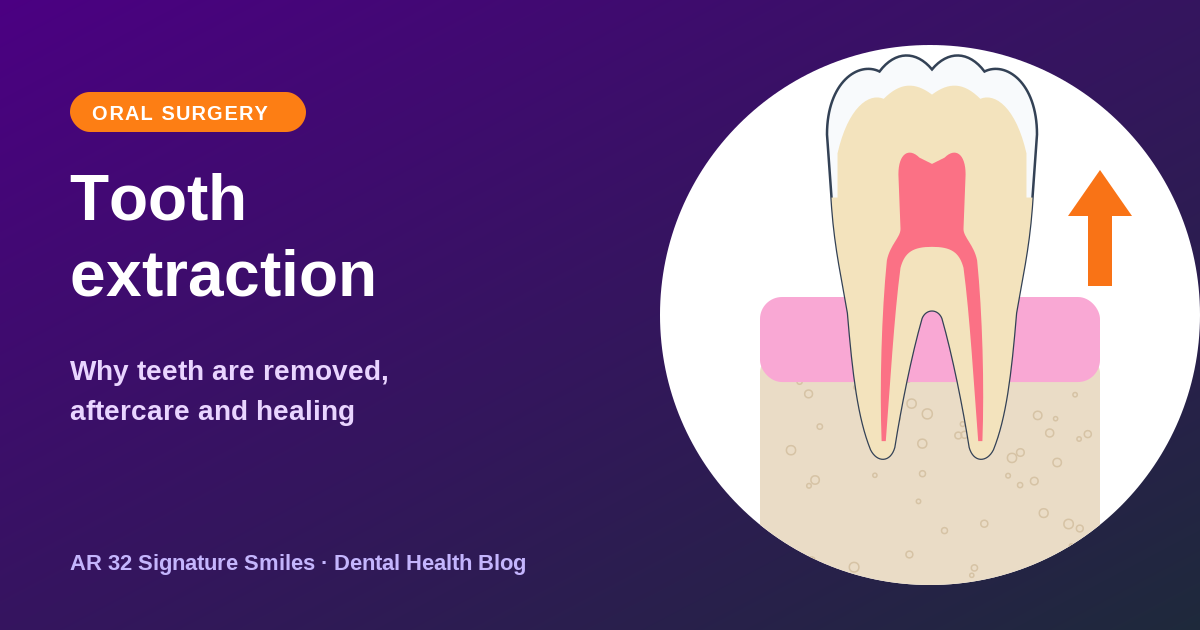
Tooth extraction is the removal of a tooth from its socket. Why teeth are taken out, the checks before, simple and surgical extractions, aftercare step by step, how the socket heals, possible complications, and replacing the tooth.
Contents
Tooth extraction is the removal of a tooth from its socket in the jaw bone. It is one of the most common procedures in dentistry. Teeth are removed when they cannot be saved — because of extensive decay, a fracture or advanced gum disease — or when keeping them would cause problems, as with some wisdom teeth or teeth removed to make space for orthodontic treatment. Most extractions are done under local anaesthetic in the dental chair.
Reasons for extraction
- Decay too extensive to restore, or a tooth that cannot be saved with root canal treatment.
- Fractures that extend deep below the gum or split the root.
- Advanced gum disease that has destroyed most of the bone support. See gum disease.
- Impacted or problem wisdom teeth causing repeated infection, decay or damage to the neighbouring tooth.
- Orthodontic treatment, to create space in a crowded mouth.
- Milk teeth that have not fallen out and are blocking the adult tooth.
- Before radiotherapy or certain medical treatments, to remove teeth with a poor outlook that could cause trouble later.
Before the extraction
A careful assessment makes an extraction safer and more predictable:
- Medical history. Tell the dentist about every medicine you take — especially blood thinners (warfarin, the newer anticoagulants, antiplatelet drugs), bone medicines such as bisphosphonates and denosumab, steroids and diabetes medicines — and about heart conditions, bleeding disorders, pregnancy and allergies.
- X-ray. Shows the shape and number of roots, how close the roots are to the sinus or the nerve in the lower jaw, and whether the tooth is likely to break.
- Blood thinners. Most people should not stop them for a routine extraction; the risk of a stroke or clot is usually greater than the risk of bleeding, which can be controlled locally. Any change must be agreed with the doctor who prescribed them.
Simple and surgical extractions
A simple extraction is for a tooth that is visible in the mouth and has roots that are likely to come out whole. After numbing, the tooth is loosened with an instrument called an elevator, which widens the socket and stretches the ligament, and then removed with forceps. You feel pressure, not pain.
A surgical extraction is needed when a tooth is broken at the gum line, has curved or brittle roots, or has not come through. The gum is opened, a little bone may be removed, and the tooth may be divided into sections so it can be taken out without excessive force. Stitches close the gum afterwards. See surgical extraction.
Aftercare
- Bite on the gauze firmly for 30 to 60 minutes. A blood clot forming in the socket is the first step of healing.
- For the first 24 hours do not rinse, spit forcefully, drink through a straw or smoke, all of which can dislodge the clot. Avoid hot drinks and alcohol.
- Eat soft food on the other side, and keep your head slightly raised when lying down that night.
- From the next day, rinse gently with warm salt water after meals for about a week, and brush the other teeth normally.
- Pain relief as advised by your dentist. Swelling is usually greatest on the second or third day, especially after surgical extractions; cold packs on the first day help.
If the socket starts bleeding again, fold a clean piece of gauze or a cotton handkerchief, place it over the socket and bite firmly for 20 to 30 minutes without checking. If it will not stop, contact the clinic.
Healing
The clot is gradually replaced by soft tissue over the first week or two, and the gum covers the socket within two to three weeks. The bone fills in over several months. As it heals, the jaw ridge shrinks somewhat, which is why planning the replacement of the tooth early can matter.
Complications
- Bleeding — usually controlled with pressure; occasionally the dentist places a dressing or stitches.
- Dry socket (alveolar osteitis) — the clot breaks down early, leaving exposed bone. It causes severe throbbing pain starting two to four days after the extraction, often with a bad taste. It is more common after lower wisdom tooth removal and in smokers. It is treated by cleaning and dressing the socket.
- Infection — increasing pain and swelling after the third day, or fever.
- Damage to neighbouring teeth or fillings.
- Nerve injury — rarely, after lower wisdom teeth, numbness or tingling of the lip, chin or tongue, usually temporary.
- Sinus communication — an upper back tooth whose roots sit in the sinus can leave a small opening; this usually heals with care and sometimes needs closing.
- Jaw stiffness after longer procedures.
- Medication-related osteonecrosis of the jaw — a rare problem in people taking certain bone medicines, mostly at high doses for cancer.
Replacing the tooth
Not every extracted tooth needs replacing — wisdom teeth do not, for example — but a missing tooth in the middle of the arch can let neighbouring teeth tip and opposing teeth over-erupt. Options include an implant, a bridge or a partial denture. Where an implant is planned, a bone graft can sometimes be placed at the time of extraction to preserve the socket. See missing tooth replacement.
Common myths
"An extraction is cheaper, so it's the better choice." It is cheaper on the day, but replacing the tooth well usually costs more than saving it.
"You can't have a tooth out while it's swollen." Sometimes removing the tooth is the quickest way to drain the infection. The dentist decides whether antibiotics are needed first.
"Taking out upper teeth affects the eyes." There is no link between extracting an upper tooth and eyesight.
What affects the cost
The difficulty of the tooth, whether a surgical approach is needed, wisdom tooth position, X-rays, and any bone graft. Current fees for basic, difficult and surgical extractions are in the treatment guide.
Extractions at AR 32
Routine extractions are carried out at our clinics; difficult, surgical and wisdom tooth extractions are handled by oral surgeons from our MDS panel where needed. See tooth extraction and wisdom tooth extraction, and quick answers in our extraction questions.
Key terms
- Alveolar bone
- The part of the jaw that holds the tooth sockets.
- Dry socket
- Painful loss of the blood clot from an extraction socket.
- Elevator
- An instrument used to loosen a tooth before removal.
- Socket preservation
- Placing graft material in a fresh socket to limit bone shrinkage.
Frequently asked questions
Will it hurt?
The anaesthetic stops pain; you feel pressure and movement. Soreness afterwards is usually managed with simple painkillers.
When can I eat?
Once the numbness has worn off. Choose soft, lukewarm food for a day or two.
When can I go back to work?
Usually the next day after a simple extraction; allow a day or two more after surgical extractions.
Do I need antibiotics?
Most extractions do not. They are prescribed for spreading infection, fever or particular medical risks.
Further reading
- On this site: Tooth extraction · Wisdom tooth extraction · Dental implants


