Implant cost, healing time, success rates and alternatives, answered by registered dental surgeons at AR 32 Signature Smiles, Kharadi.
Answered by Dr Avinash Bamane (A-18814) and Dr Rashmi Bamane (A-22726),
Maharashtra State Dental Council. General information, not a diagnosis — nothing here
replaces looking in your mouth.
Full answer · 609 words
how long do dental implants last
A well-placed dental implant can last for decades, and many last a lifetime, because the titanium post fuses with your jawbone and cannot decay. The crown on top wears like any crown and often needs replacing after ten to fifteen years. How long yours lasts depends mostly on your gums, smoking, diabetes control and whether you grind your teeth.
Answered by Dr Kaustubh Patil, MDS (Periodontics) · Approved by Dr Avinash Bamane (A-18814) · Last reviewed 23 October 2026
Full answer · 619 words
does a dental implant hurt
Placing a dental implant should not hurt during the procedure, because the area is fully numbed with local anaesthetic; most people feel pressure and vibration rather than pain. Afterwards, expect soreness and some swelling for two to four days, usually controlled with ordinary painkillers. Many patients say it felt easier than the extraction that came before it.
Answered by Dr Rakesh Mutha, MDS (Periodontics) · Approved by Dr Rashmi Bamane (A-22726) · Last reviewed 23 October 2026
Full answer · 552 words
how much does a dental implant cost
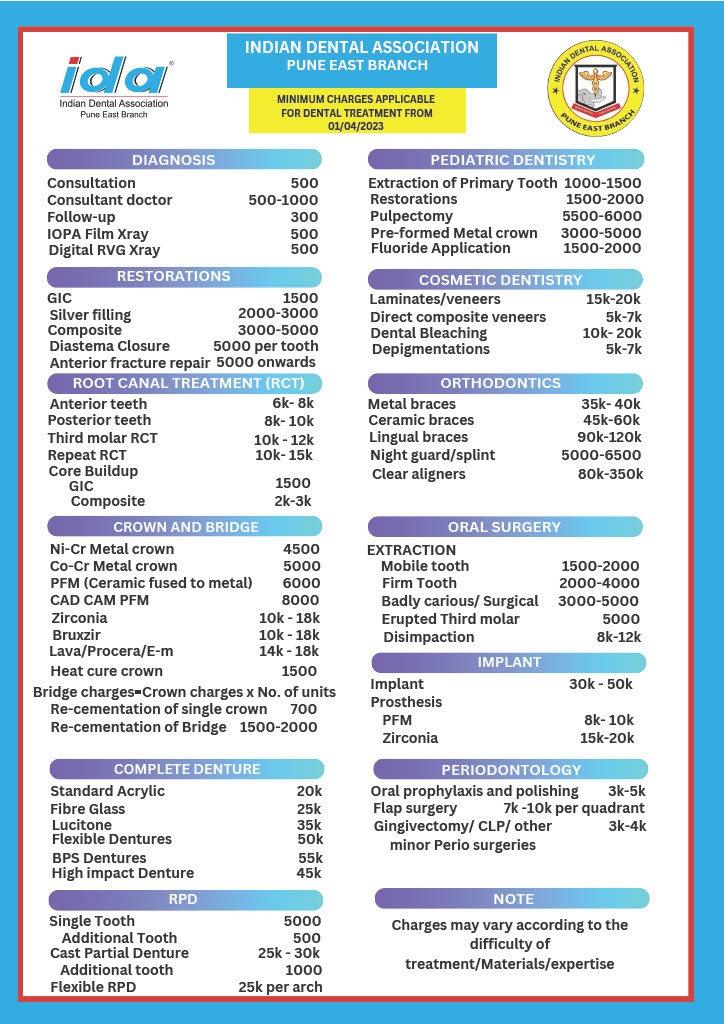
Our current published fee for a single dental implant is from ₹80,000, which covers the implant, the abutment (the connector) and the crown. Premium implant systems are quoted separately, and a bone graft, if your scan shows you need one, is ₹15,000 per site. Your final cost is confirmed only after examination and planning.
Answered by Dr Sanjay Jain, MDS (Periodontics) · Approved by Dr Avinash Bamane (A-18814) · Last reviewed 23 October 2026
Full answer · 565 words
how long does the whole implant process take
For a single implant, expect roughly three to six months from implant surgery to the final crown, because the bone needs time to fuse with the implant. If the tooth must be removed first, or you need a bone graft or sinus lift, the whole journey can stretch to nine months or longer. Only a handful of the visits are long ones.
Answered by Dr Sumanth S, MDS (Periodontics) · Approved by Dr Rashmi Bamane (A-22726) · Last reviewed 23 October 2026
Full answer · 511 words
am i too old for a dental implant
There is no upper age limit for dental implants. People in their seventies and eighties have implants placed; what matters is your general health, bone, medicines and ability to keep the implant clean, not your birth year. A full medical history and, where needed, a word with your physician usually settles whether an implant is sensible for you.
Answered by Dr Rohan Kale, MDS (Periodontics) · Approved by Dr Avinash Bamane (A-18814) · Last reviewed 23 October 2026
Full answer · 533 words
can a diabetic patient have a dental implant
Yes, most people with diabetes can have dental implants, provided their blood sugar is well controlled. Poorly controlled diabetes slows healing and raises the risk of infection and implant failure, so your dentist will usually ask for a recent HbA1c test (your average sugar over about three months) and may coordinate with your physician before surgery.
Answered by Dr Nachiket Shah, MDS (Periodontics) · Approved by Dr Rashmi Bamane (A-22726) · Last reviewed 23 October 2026
Full answer · 544 words
what happens if a dental implant fails
If an implant fails, it usually becomes loose, painful or infected and is removed, which is normally a simple procedure because it is no longer fused to the bone. The site is cleaned and allowed to heal, often with a bone graft, and in many cases a new implant can be placed a few months later. A bridge or partial denture is the alternative.
Answered by Dr Abhishek Kamble, MDS (Periodontics) · Approved by Dr Avinash Bamane (A-18814) · Last reviewed 23 October 2026
Full answer · 544 words
is an implant better than a bridge
An implant is often the better long-term choice when the teeth on either side of a gap are healthy, because a bridge needs those neighbours trimmed down for crowns. A bridge can be the more sensible option when the neighbours already need crowns, when bone is poor, or when you want a fixed tooth sooner and for less. Neither suits everyone.
Answered by Dr Bhushan Bangar, MDS (Prosthodontics) · Approved by Dr Rashmi Bamane (A-22726) · Last reviewed 23 October 2026
Full answer · 565 words
can i get an implant immediately after extraction
Sometimes, yes. An implant can often be placed in the same visit as the extraction when the socket walls are intact, there is no active pus infection, and the implant can be held firmly in the surrounding bone. When those conditions are not met, your dentist will usually wait six to twelve weeks, or longer after a bone graft, before placing it.
Answered by Dr Kaustubh Patil, MDS (Periodontics) · Approved by Dr Rashmi Bamane (A-22726) · Last reviewed 23 October 2026
Full answer · 541 words
what is a bone graft and will i need one
A bone graft adds bone or bone-like material where your jaw is too thin or too short to hold an implant securely. You are more likely to need one if the tooth was lost long ago, if infection or gum disease destroyed bone, or for upper back teeth. Whether you need it is decided from X-rays and usually a CBCT scan, not guessed.
Answered by Dr Rakesh Mutha, MDS (Periodontics) · Approved by Dr Avinash Bamane (A-18814) · Last reviewed 23 October 2026
Full answer · 477 words
can a smoker have a dental implant
Yes, smokers can have dental implants, but smoking clearly raises the risk of slow healing, infection and implant failure, both in the first months and years later. Your dentist will ask you to stop around surgery at the very least. Quitting altogether gives the implant its strongest chance, and gutkha, mishri and other tobacco carry similar risks.
Answered by Dr Sumanth S, MDS (Periodontics) · Approved by Dr Avinash Bamane (A-18814) · Last reviewed 23 October 2026
Full answer · 505 words
can an implant get infected
Yes. An implant cannot decay, but the gum and bone around it can become infected, either in the first weeks after surgery or years later. Warning signs are swelling, bleeding or pus around the implant, a bad taste, pain when biting, or gum shrinking to show metal. Caught early, most implant infections can be treated and the implant kept.
Answered by Dr Abhishek Kamble, MDS (Periodontics) · Approved by Dr Rashmi Bamane (A-22726) · Last reviewed 23 October 2026
Full answer · 594 words
is a cheaper implant brand a bad idea
Not necessarily, but it can be. A lower-priced implant from an established, well-documented system can be perfectly reasonable. The real risks are unknown brands with little research behind them, spare parts that are hard to find years later when a screw or crown needs replacing, and cheap quotes that save money on planning, skill or the crown rather than the screw.
Answered by Dr Kaustubh Patil, MDS (Periodontics) · Approved by Dr Rashmi Bamane (A-22726) · Last reviewed 23 October 2026
Full answer · 557 words
can i replace all my teeth with implants
Yes, if your general health and jawbone allow it. You do not need one implant per tooth: a full set of fixed teeth in one jaw is usually held on four to six implants, while a removable denture can clip onto two to four. It is a major and costly treatment, so careful planning with imaging and a specialist team comes first.
Answered by Dr Rakesh Mutha, MDS (Periodontics) · Approved by Dr Avinash Bamane (A-18814) · Last reviewed 23 October 2026
Full answer · 509 words
is an implant possible for a front tooth
Yes, implants are often used to replace front teeth, but the front is the most demanding place to get right, because the gum line and thin bone are on show every time you smile. Careful planning, sometimes a bone or gum graft, and a well-matched crown decide the result. A temporary tooth is usually arranged so you are not left with a gap.
Answered by Dr Sumanth S, MDS (Periodontics) · Approved by Dr Avinash Bamane (A-18814) · Last reviewed 23 October 2026
how do i clean a dental implant
Clean a dental implant much like a natural tooth: brush twice a day with a soft brush, angled at the gumline, and clean around the base once a day with an interdental brush, floss or a water flosser. Implants cannot decay, but the gum and bone around them can become infected, so daily cleaning and regular professional check-ups matter.
An implant crown looks like a tooth, but the gum around it behaves a little differently. It does not have the same fibre attachment as a natural tooth, so bacteria that collect at the gumline can travel down towards the bone more easily. That is why the junction between crown and gum gets most of your attention.
Your daily routine
Brush twice daily with a soft or medium brush, tilted towards the gum. An electric brush is helpful but not essential.
Clean between once a day. A correctly sized interdental brush is often easiest. Implant-specific floss or ordinary floss wrapped around the base also works.
A water flosser is useful for implant bridges and full-arch teeth, where floss cannot reach under the bridge.
Non-abrasive toothpaste: avoid harsh whitening or charcoal powders that can scratch the crown.
What to avoid
Metal toothpicks, pins or safety pins to dig out food; they scratch the surface and injure the gum.
Opening bottles or cracking supari with your teeth.
Tobacco in any form, which is the biggest long-term threat to the bone around implants.
Professional cleaning
Have the implant checked and cleaned every six months, or every three to four months if you have had gum disease, smoke or are diabetic. Your dentist uses instruments suitable for implant surfaces and takes an X-ray from time to time to check the bone level. See our scaling page for what a professional cleaning involves.
Bleeding when you clean around the implant is not something to brush harder through; it is an early sign of inflammation and worth a check. More answers are in our dental implants Q&A.
Answered by Dr Deepali Fallerio, MDS (Periodontics) · Approved by Dr Avinash Bamane (A-18814) · Last reviewed 23 October 2026
what is a sinus lift
A sinus lift is a bone-graft procedure in the upper back jaw. The thin floor of the maxillary sinus, the air space above your upper molars and premolars, is gently raised and graft material is placed beneath it, creating enough bone height to hold an implant. It is needed only when an X-ray or CBCT scan shows the bone there is too short.
After an upper back tooth is lost, two things happen at once: the bone shrinks from below and the sinus tends to expand from above. The bone left between the mouth and the sinus can become just a few millimetres thick, too little to anchor an implant. A sinus lift solves this by adding height from the top.
Two common approaches
Through the implant site (crestal or internal lift): used when a modest amount of extra height is needed. The sinus floor is nudged up through the same opening as the implant, a little graft is added, and the implant often goes in the same day.
Through a side window (lateral lift): used when the bone is very thin. A small window is made in the side wall of the jaw, the sinus lining is lifted, and graft is packed beneath it. The implant may be placed together or several months later.
Recovery
Expect swelling and soreness for several days, and sometimes a little bleeding from the nose. For the first couple of weeks you are usually asked not to blow your nose forcefully, to sneeze with your mouth open, and to avoid straws and heavy exercise. Ask your surgeon before flying. Healing before the implant can be loaded commonly takes several months.
The decision is based on imaging, usually a CBCT scan, and is planned by an oral and maxillofacial surgeon or an implant-trained specialist; see our oral surgery department. If the bone loss is borderline, shorter implants or a bridge may be alternatives worth discussing. More in our dental implants Q&A.
Answered by Dr Sanjay Jain, MDS (Periodontics) · Approved by Dr Rashmi Bamane (A-22726) · Last reviewed 23 October 2026
how do i know if i have enough bone for an implant
You cannot tell by looking or feeling; bone is measured with imaging. A dental X-ray shows the height of bone between neighbouring teeth, and a CBCT scan, a low-dose 3D X-ray, shows width, height and how close the nerve or sinus is. Teeth missing for years, past infection, gum disease and long-term denture wear are the usual reasons bone is short.
An implant needs enough bone in height, so it is long enough to grip, and in width, so there is a wall of bone on both sides. It must also stay clear of the nerve in the lower jaw and the sinus in the upper jaw.
How it is measured
Examination: your dentist feels the ridge and looks at the gum. A sunken or narrow ridge is a clue, but not a measurement.
Digital X-ray (RVG): taken at the clinic, our current published fee is ₹500. It shows bone height and the neighbouring roots.
CBCT scan: may be advised for implant planning because it shows the bone in three dimensions. We do not do CBCT in-clinic; we will tell you where it is done and what it costs.
If there is not enough
Options include a bone graft, a sinus lift in the upper back jaw, a shorter or narrower implant, placing the implant at a slightly different angle, or choosing a bridge or denture instead. Your specialist explains which fits your scan and your preferences. Imaging-led planning is the work of our oral radiology department. More in our dental implants Q&A.
Answered by Dr Rohan Kale, MDS (Periodontics) · Approved by Dr Rashmi Bamane (A-22726) · Last reviewed 23 October 2026
do dental implants set off airport metal detectors
Almost never. Dental implants are small pieces of titanium, a non-magnetic metal, sitting inside your jawbone, and they are far too small to set off airport metal detectors or body scanners. You do not need a card or letter to travel with them. Zirconia implants contain no metal at all, so they are not an issue either.
Airport detectors respond to larger amounts of metal, such as belt buckles, keys or a hip replacement. A dental implant weighs a gram or two, and the crown on top is usually porcelain or zirconia. People with several implants, or even full-arch implant bridges, travel through Pune and international airports without any trouble.
Related questions
MRI scans: titanium implants are not magnetic and are generally considered safe in MRI machines, though they can cause small shadows on images of the jaw. Always tell the radiographer you have implants.
Flying after implant surgery: after a routine implant, flying a few days later is usually fine. After a sinus lift, ask your surgeon first, as pressure changes can affect healing.
Travelling for treatment: if you are visiting Pune for an implant, plan for two trips, one for surgery and one for the crown months later. See our dental tourism page.
If an implant ever feels loose or sore while you are travelling, avoid chewing on it and get it checked when you can. More answers are in our dental implants Q&A.
Answered by Dr Nachiket Shah, MDS (Periodontics) · Approved by Dr Avinash Bamane (A-18814) · Last reviewed 23 October 2026
what is peri implantitis
Peri-implantitis is a gum-disease-like infection around a dental implant that destroys the bone supporting it. It begins as peri-implant mucositis, bleeding and swollen gum that can still be reversed, and then progresses quietly, often without pain. Left untreated, the implant loosens and may be lost. Smokers, people with past gum disease and poorly cleaned implants are most at risk.
Think of peri-implantitis as the implant version of periodontitis, the advanced gum disease that loosens natural teeth. Plaque bacteria settle where the crown meets the gum, the body reacts with inflammation, and over months or years that inflammation eats away the bone holding the implant.
Stages
Peri-implant mucositis: red, puffy gum that bleeds on cleaning. No bone loss yet. Reversible with professional cleaning and better home care.
Peri-implantitis: bone loss visible on an X-ray, deeper gum pockets, sometimes pus or receding gum showing threads.
Advanced: large bone loss and a mobile implant, which usually has to be removed.
Treatment and prevention
Treatment ranges from deep cleaning and antiseptics to gum surgery to clean the implant surface, sometimes with grafting. Prevention is simpler: daily cleaning at the gumline, regular check-ups with periodic X-rays, controlling diabetes, stopping tobacco, and treating any existing gum disease before an implant is placed. Our periodontitis page explains the closely related gum disease, and the periodontics department handles both.
Answered by Dr Deepali Fallerio, MDS (Periodontics) · Approved by Dr Avinash Bamane (A-18814) · Last reviewed 23 October 2026
how many implants do i need for a full arch
Most fixed full-arch bridges need four to six implants per jaw, while a removable denture that clips onto implants can work with two in the lower jaw and usually four in the upper. The exact number depends on bone quantity and quality, bite force, jaw shape and whether you want fixed or removable teeth, so it is decided after a CBCT scan.
You do not need an implant for every missing tooth. A full arch of teeth can be carried on a few well-placed implants, much like a bridge spans a river on a few strong pillars.
Typical numbers
Lower overdenture: two implants, the most common and economical choice for a loose lower denture.
Upper overdenture: usually four, because upper bone is softer.
Fixed full-arch bridge: four implants in good conditions, often with the back ones angled to avoid the nerve or sinus. Five or six are used where bone is softer, bite is strong or a longer bridge is planned.
Why it varies
The upper jaw generally needs more support than the lower. Heavy grinders, people with strong bites and those with softer bone benefit from extra implants. Fewer implants can save money but leave less margin if one fails; more is not always better either, as crowding implants makes cleaning harder.
Answered by Dr Sanjay Jain, MDS (Periodontics) · Approved by Dr Rashmi Bamane (A-22726) · Last reviewed 23 October 2026
what is the failure rate of dental implants
Dental implants fail in only a small minority of cases. In healthy non-smokers with good planning, the large majority are still working ten or more years later. The risk rises noticeably with smoking, poorly controlled diabetes, untreated gum disease, teeth grinding and poor cleaning, so any figure you are quoted is an average, not a promise for your mouth.
You will find many percentages online, and some clinics quote them as selling points. We prefer not to, because an average across thousands of patients says little about you. What matters is which group you belong to.
Two kinds of failure
Early: the implant does not fuse with the bone in the first few months. It is linked to infection, smoking, poor bone, overheating during drilling or loading the implant too soon.
Late: an implant that worked for years loses bone, usually from peri-implantitis, or from overload in heavy grinders.
What pushes your risk up or down
Higher risk: smoking or chewing tobacco, uncontrolled diabetes, past gum disease, heavy grinding, radiotherapy to the jaw, and poor cleaning.
Lower risk: good general health, enough bone, careful planning with imaging, an experienced specialist, daily cleaning and regular check-ups.
Upper back implants and grafted sites can carry slightly more risk than lower front ones. Ask your dentist where your own case sits, and what happens if the implant fails. A gum specialist from our periodontics department can help manage risk if you have had gum disease. More in our dental implants Q&A.
Answered by Dr Rohan Kale, MDS (Periodontics) · Approved by Dr Rashmi Bamane (A-22726) · Last reviewed 23 October 2026
Still not sure?
A question answered online is general. An examination is specific to your tooth.
Kharadi runs late, and reception will tell you honestly if you do not need to come in yet.