Primary (milk) teeth
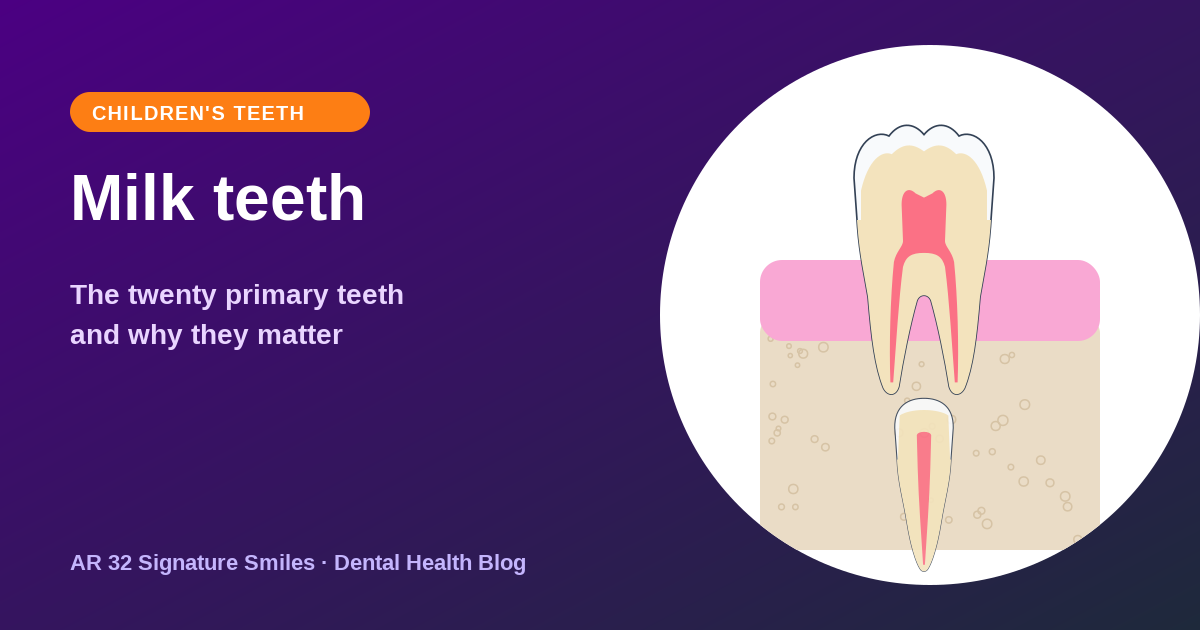
Children have twenty milk teeth, which arrive from about six months and are shed between six and twelve years. When each tooth comes and goes, why milk teeth matter, how they differ from adult teeth, how to care for them, and their common problems.
Contents
Primary teeth, also called milk teeth, baby teeth or deciduous teeth, are the first set of teeth. A child has twenty of them: they begin to come through at around six months of age, are usually all present by about two and a half to three years, and are shed between about six and twelve years as the permanent teeth replace them. Although they are temporary, milk teeth do important work for many years, and their health affects the adult teeth that follow.
The twenty milk teeth
In each jaw there are four incisors at the front, two canines and four molars — ten in each jaw. There are no premolars in the primary set; the permanent premolars later grow in where the milk molars were. Dentists often label milk teeth with letters (A to E from the middle backwards) or with the FDI numbers 51–55, 61–65, 71–75 and 81–85.
When they come in
The timing varies a great deal between children and a few months either way is normal. A typical order is:
| Tooth | Usual arrival | Usual loss |
|---|---|---|
| Lower central incisors | 6–10 months | 6–7 years |
| Upper central incisors | 8–12 months | 6–7 years |
| Lateral incisors | 9–16 months | 7–8 years |
| First molars | 13–19 months | 9–11 years |
| Canines | 16–23 months | 9–12 years |
| Second molars | 23–33 months | 10–12 years |
The first permanent molars usually come through at about six years, behind the last milk molars, without replacing any milk tooth. Parents often mistake them for milk teeth, which matters because they are permanent and need protecting.
Why milk teeth matter
- Eating and nutrition. Painful, decayed teeth make children avoid food.
- Speech. The front teeth help form sounds.
- Space keeping. Each milk tooth holds space for its permanent successor. If a milk molar is lost early, neighbouring teeth drift and the adult tooth can be blocked out, leading to crowding. See malocclusion.
- Guiding the adult teeth. Permanent teeth develop directly beneath the milk teeth. Infection around a milk tooth's roots can damage the enamel of the tooth forming underneath.
- Confidence and comfort during the years they are present — the back milk molars are in use until around 11 or 12.
How milk teeth differ from adult teeth
- Thinner enamel and dentine, so decay reaches the nerve faster.
- Relatively larger pulp chambers.
- Whiter in colour and smaller.
- Roots that naturally dissolve (resorb) as the permanent tooth pushes up, which is why milk teeth become loose and fall out.
Looking after milk teeth
- Start brushing as soon as the first tooth appears, twice a day, with a soft, small brush.
- Use fluoride toothpaste in the right amount. Under three years, a smear (a thin film, the size of a grain of rice); from three to six, a pea-sized amount. Encourage spitting out rather than rinsing.
- Brush for your child, or supervise closely, until about seven or eight years old — young children lack the dexterity to brush well.
- Limit sugar to mealtimes. Avoid sweet drinks in bottles or sipper cups, and do not let a child fall asleep with a bottle of milk or juice.
- See a dentist by the first birthday or when the first teeth appear, then regularly.
Problems with milk teeth
Decay
Early childhood caries is decay in children under six. It often starts on the upper front teeth near the gum, as white chalky lines that turn brown. Frequent bottle or night feeds with milk or sweet drinks, sweet snacks and lack of brushing with fluoride toothpaste are the main causes. See tooth decay.
Treatment of decayed milk teeth
- Fluoride varnish and diet changes to stop early decay.
- Fillings with glass ionomer or composite.
- Pulpotomy or pulpectomy — nerve treatment for milk teeth, removing the inflamed pulp in the crown or the whole pulp.
- Stainless steel or tooth-coloured crowns to cover heavily decayed milk molars.
- Extraction, followed where needed by a space maintainer that holds the gap for the adult tooth.
Injuries
Toddlers often knock their front milk teeth when learning to walk. The tooth may be pushed in, loosened or knocked out. A knocked-out milk tooth should not be put back, because doing so can damage the adult tooth developing underneath. A child with a dental injury should be checked by a dentist, and a tooth that later turns grey should be reviewed.
Teething
Teething can cause drooling, chewing, irritability and red gums. It does not cause high fever or diarrhoea; a baby with those symptoms should be assessed by a doctor.
Over-retained milk teeth
Sometimes a permanent tooth comes through behind a milk tooth that has not fallen out ("shark teeth"). If the milk tooth does not loosen within a few weeks, a dentist may remove it.
Common myths
"Cavities in milk teeth don't matter because they fall out." Some milk molars stay until age 12. Decay causes pain, infection and early loss with crowding.
"Children shouldn't use fluoride toothpaste." A smear or pea-sized amount, used correctly, is safe and strongly protective.
"The first dental visit should wait until the child is older." Early visits are mainly preventive and help children get used to the dentist.
Children's dentistry at AR 32
Children are seen at our clinics, with paediatric dentists from our MDS panel for younger or anxious children and more complex treatment. See quick answers in our children and dentistry questions.
Key terms
- Deciduous
- Shed naturally; used of milk teeth.
- Exfoliation
- The natural loss of a milk tooth.
- Pulpotomy
- Removal of the inflamed pulp in the crown of a milk tooth.
- Space maintainer
- An appliance that holds space for an adult tooth after a milk tooth is lost early.
Frequently asked questions
My baby is 12 months old with no teeth. Is that a problem?
Usually not; some babies get their first tooth after their first birthday. If no teeth have appeared by about 18 months, have a dentist check.
Should a wobbly milk tooth be pulled?
Let it come out naturally or with gentle wiggling. Forcing a tooth that is not ready can be painful.
Do milk teeth need fillings?
Yes, if they are decayed and not about to fall out. The dentist judges this from the X-ray and the child's age.
Further reading
- On this site: Tooth decay · Malocclusion


