Wisdom tooth pain, removal, cost and recovery in Pune, answered by registered dental surgeons at AR 32 Signature Smiles.
Answered by Dr Avinash Bamane (A-18814) and Dr Rashmi Bamane (A-22726),
Maharashtra State Dental Council. General information, not a diagnosis — nothing here
replaces looking in your mouth.
Full answer · 592 words
do all wisdom teeth need to be removed
No. A wisdom tooth that has come through straight, can be cleaned properly, bites against its partner and shows no decay, gum disease or damage to the neighbouring tooth can simply stay. Removal is advised when the tooth is causing repeated infection, decay, cyst formation or harm to the molar in front, or when it clearly cannot erupt and is likely to cause trouble.
Answered by Dr Vikrant Prasad, MDS (Oral & Maxillofacial Surgery) · Approved by Dr Avinash Bamane (A-18814) · Last reviewed 23 October 2026
Full answer · 567 words
how painful is wisdom tooth removal
The removal itself should not be painful, because local anaesthetic numbs the tooth, gum and bone; you feel pressure and pushing rather than sharp pain. Soreness, swelling and some jaw stiffness are normal for a few days afterwards. A simple, fully erupted wisdom tooth is usually much easier than a deeply impacted lower one that needs surgery.
Answered by Dr Shrama Darekar, MDS (Oral & Maxillofacial Surgery) · Approved by Dr Rashmi Bamane (A-22726) · Last reviewed 23 October 2026
Full answer · 548 words
how long does it take to recover from wisdom tooth surgery
Most people feel fairly normal in three to five days after a simple wisdom tooth removal, and in about a week after surgery for an impacted lower tooth. Swelling and stiffness usually peak on day two and settle by day five to seven. The gum closes over in two to three weeks, while the bone underneath keeps healing quietly for a few months.
Answered by Dr Pratik Raut, MDS (Oral & Maxillofacial Surgery) · Approved by Dr Avinash Bamane (A-18814) · Last reviewed 23 October 2026
Full answer · 538 words
how much does wisdom tooth removal cost
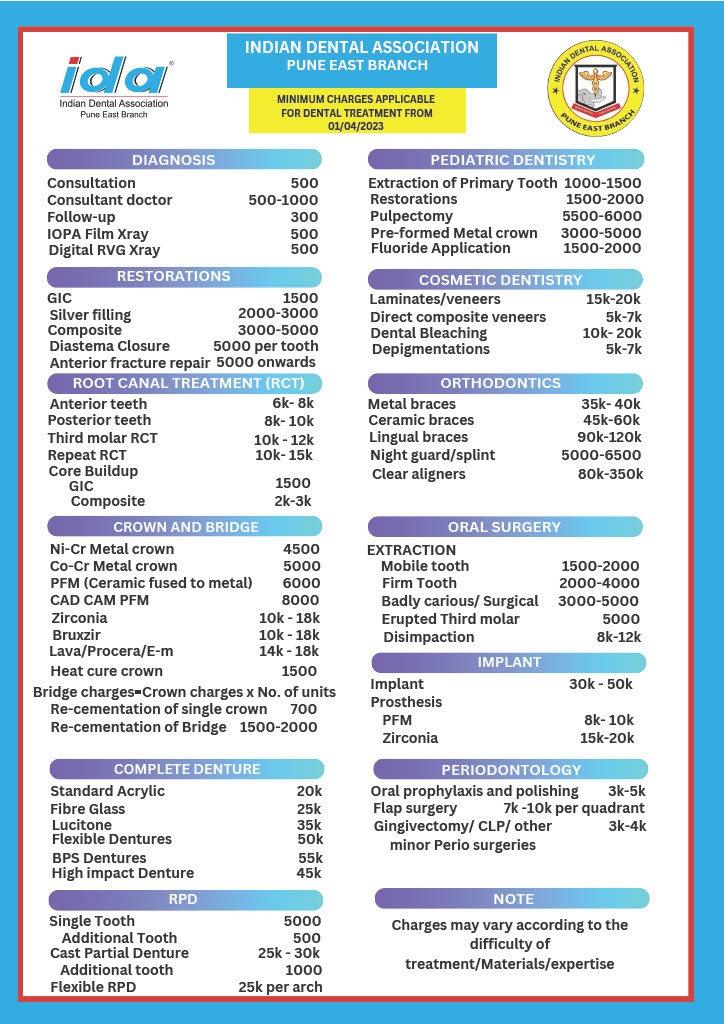
At AR 32, our current published fee for wisdom tooth extraction ranges from ₹6,000 for an easy case to ₹18,000 for a tooth lying close to the nerve, per tooth. The grade depends on how the tooth sits in the bone, which is seen on examination and X-ray, so the final cost is confirmed only after your dentist has assessed it.
Answered by Dr Chinmay Gokhale, MDS (Oral & Maxillofacial Surgery) · Approved by Dr Rashmi Bamane (A-22726) · Last reviewed 23 October 2026
Full answer · 528 words
what is an impacted wisdom tooth
An impacted wisdom tooth is one that cannot come through into its normal place in the mouth, because it is blocked by the tooth in front, by bone or by thick gum. It may stay fully buried or break through only partly. Many impacted teeth cause no trouble, but partly erupted ones often trap food and lead to infection or decay.
Answered by Dr Kedar Vaidya, MDS (Oral & Maxillofacial Surgery) · Approved by Dr Avinash Bamane (A-18814) · Last reviewed 23 October 2026
Full answer · 556 words
why does my jaw not open properly after wisdom tooth pain
Difficulty opening your mouth after wisdom tooth pain is called trismus. It usually happens because infection around a partly erupted lower wisdom tooth, called pericoronitis, inflames the chewing muscles next to it, which then go into protective spasm. It needs a dental examination soon, and urgent care if swelling spreads or swallowing or breathing becomes difficult.
Answered by Dr Mayank Patil, MDS (Oral & Maxillofacial Surgery) · Approved by Dr Rashmi Bamane (A-22726) · Last reviewed 23 October 2026
Full answer · 543 words
can a wisdom tooth cause pain in other teeth
Yes. A wisdom tooth can cause pain that you feel in the molar in front, in the ear, the jaw joint, the throat or even the upper teeth. Sometimes the pain is referred, meaning nerves share signals; sometimes the wisdom tooth has actually damaged the tooth in front, causing decay or bone loss there. An X-ray usually shows which it is.
Answered by Dr Pradip Thorat, MDS (Oral & Maxillofacial Surgery) · Approved by Dr Avinash Bamane (A-18814) · Last reviewed 23 October 2026
Full answer · 569 words
can a wisdom tooth be filled instead of removed
Sometimes, yes. A wisdom tooth that has erupted fully, bites against its partner, can be cleaned well and has decay that your dentist can reach can be filled like any other molar. If the cavity is hard to reach, the tooth is tilted or half-buried, or it has no opposing tooth, filling is usually a poor investment and removal is advised instead.
Answered by Dr Sunny Deshmukh, MDS (Oral & Maxillofacial Surgery) · Approved by Dr Rashmi Bamane (A-22726) · Last reviewed 23 October 2026
Full answer · 504 words
is swelling normal after wisdom tooth removal
Yes. Swelling after wisdom tooth removal is a normal part of healing, especially after surgery on an impacted lower tooth. It usually builds over the first day or two, peaks around day two or three, and then settles over the following days. Swelling that keeps increasing after day three, or comes with fever or pus, needs to be checked.
Answered by Dr Shrama Darekar, MDS (Oral & Maxillofacial Surgery) · Approved by Dr Rashmi Bamane (A-22726) · Last reviewed 23 October 2026
Full answer · 536 words
when can i eat normally after wisdom tooth surgery
Most people can eat fairly normally in about a week after wisdom tooth surgery. Stick to cool, soft foods on the first day, move to soft home food like khichdi, dal-rice and upma over days two to four, and go back to firmer foods gradually as the soreness settles. Chew on the other side, and avoid hard, crunchy or very spicy food for a week.
Answered by Dr Pratik Raut, MDS (Oral & Maxillofacial Surgery) · Approved by Dr Avinash Bamane (A-18814) · Last reviewed 23 October 2026
Full answer · 487 words
can wisdom teeth crowd my front teeth
Probably not by much. Current evidence suggests wisdom teeth play only a small role, if any, in crowding of the lower front teeth, which happens naturally with age in most people, whether or not they have wisdom teeth. Removing healthy wisdom teeth just to prevent crowding is not usually recommended. A retainer is the reliable way to stop teeth shifting after braces.
Answered by Dr Chinmay Gokhale, MDS (Oral & Maxillofacial Surgery) · Approved by Dr Rashmi Bamane (A-22726) · Last reviewed 23 October 2026
is wisdom tooth removal done under general anaesthesia
In most cases, no. Wisdom tooth removal is routinely done under local anaesthetic, which numbs the area completely while you stay awake. Being put fully to sleep is reserved for a small number of complex cases and is done in a hospital setting with an anaesthetist. If you are very anxious, please tell us at registration so we can plan the visit accordingly.
Almost all wisdom tooth removals, including many surgical ones, are done with local anaesthetic (an injection that numbs the tooth, gum, bone and part of the lip and tongue on that side). You stay awake and can talk, but you should not feel sharp pain. You will feel pressure and pushing, which is normal.
When being put to sleep is considered
Full anaesthesia, where you are unconscious, is a hospital procedure needing an anaesthetist, fasting and recovery monitoring. It carries its own risks, so specialists reserve it for situations such as removing all four deeply impacted teeth together, very extensive surgery, or certain medical or special-needs situations. Your surgeon will tell you if your case falls into this group.
What we offer
We do not list a put-to-sleep option at our clinics. If you have questions about it for your own case, please ask us; call 8484 990 678. What we do is plan time: our appointments are long slots, so nobody is rushed, and our registration form asks how anxious you are so we can pace the visit. Difficult cases are planned with our oral and maxillofacial surgery department. Read more on our wisdom tooth extraction page.
Answered by Dr Pratik Hande, MDS (Oral & Maxillofacial Surgery) · Approved by Dr Rashmi Bamane (A-22726) · Last reviewed 23 October 2026
what age do wisdom teeth usually come
Wisdom teeth usually come through between about 17 and 25 years of age, though some appear later and some never erupt at all. They are the third molars, the last teeth at the back of each jaw. Their crowns start forming around the age of ten, so an X-ray can show them in the bone long before they appear.
Wisdom teeth are the third molars, and they are called "wisdom" teeth simply because they arrive when you are older than for any other tooth. Most people notice them between their late teens and mid-twenties, often as a pressure or soreness behind the last molar.
The typical pattern
Around 9 to 10 years: the crown starts forming deep in the jaw.
Mid-teens: the crown is complete and roots begin to form.
About 17 to 25 years: eruption, if there is room.
Why the timing varies
Some people never develop one or more wisdom teeth. Others have them stuck in bone because there is not enough space, which is called impaction. A tooth can also appear in your thirties or later, often when the gum over a slowly moving tooth gets inflamed. Teething pain at the back in your twenties is common and usually comes in short bouts.
If the gum at the back stays swollen, tastes bad or makes opening the mouth difficult, have it checked; this may be pericoronitis. More on our page about wisdom tooth problems.
Answered by Dr Rahul Bagrecha, MDS (Oral & Maxillofacial Surgery) · Approved by Dr Avinash Bamane (A-18814) · Last reviewed 23 October 2026
will removing wisdom teeth change my face shape
For almost everyone, no. Wisdom teeth sit inside the jaw bone, behind the other molars, and do not hold up your cheeks or jawline. Any change in face shape after removal is temporary swelling, which settles within about a week. Your facial outline comes from the bone, muscles and fat of the face, which removing a wisdom tooth does not change.
This worry often comes from social media posts claiming that wisdom tooth removal "slims" the face or, on the other side, makes the cheeks sink. Neither is supported by mainstream dental evidence for a routine extraction.
Why the face does not change
Wisdom teeth are the last molars, tucked at the very back of the jaw. Your cheeks are supported by the cheekbones, the jaw bone, the chewing muscles and facial fat, not by these teeth. After removal, the socket fills with bone over a few months, and the jaw keeps its shape. The teeth that support your lips and the lower face, the front teeth and premolars, are untouched.
What you may notice
Swelling of the cheek for two to five days, sometimes uneven if only one side was treated.
Bruising occasionally, which fades within one to two weeks.
A slight hollow feeling with your tongue, where the tooth used to be. It is inside the mouth, not visible from outside.
A rare exception
Very extensive jaw surgery, or losing many teeth with no replacement, can change the face over years. That is a different situation from removing wisdom teeth. Ask our oral and maxillofacial surgery department if you have specific concerns. More on our wisdom tooth extraction page.
Answered by Dr Laxman Revansidh Malkunje, MDS (Oral & Maxillofacial Surgery) · Approved by Dr Avinash Bamane (A-18814) · Last reviewed 23 October 2026
why does my wisdom tooth hurt only sometimes
A wisdom tooth often hurts on and off because the gum over a partly erupted tooth flares up and settles. Food and bacteria collect under the gum flap, and when your resistance drops during a cold, stress, poor sleep or exams, the gum swells and aches. It then calms down, but the cause remains, so the episodes usually return.
Intermittent wisdom tooth pain is very common, and the pattern itself is a clue. It usually points to the gum around the tooth rather than a cavity inside it.
The flare-and-settle cycle
A partly erupted wisdom tooth has a flap of gum over part of it. Food and bacteria collect underneath. Most of the time your body keeps this under control. When resistance drops, or a bit of food gets stuck, the gum swells, the opposite tooth bites on it, and it swells more. This is pericoronitis. After some days, especially with careful cleaning, it settles, and you forget about it until next time.
Other reasons for on-and-off pain
Eruption pressure: the tooth moving slowly, causing short spells of ache.
Decay on the wisdom tooth or the molar in front, causing pain with cold drinks, chai or sweets.
Food packing between the wisdom tooth and the molar in front.
Why "it went away" is not the end
Each flare tends to be a little worse than the last, and some lead to swelling or difficulty opening the mouth. Have it examined between flare-ups, when it is easier to assess. More on our page about wisdom tooth problems, or book a consultation.
Answered by Dr Soumyabrata Ghosh, MDS (Oral & Maxillofacial Surgery) · Approved by Dr Rashmi Bamane (A-22726) · Last reviewed 23 October 2026
can a wisdom tooth cause bad breath
Yes. A partly erupted wisdom tooth often causes bad breath, because food and bacteria get trapped under the gum flap over it, or between it and the molar in front, where a brush cannot reach. Infection of that gum flap, called pericoronitis, or decay in a wisdom tooth, can add a foul taste as well as a smell.
Wisdom teeth are a common, overlooked source of bad breath. The area at the very back of the mouth is hard to see and hard to clean, and the bacteria living there produce strong-smelling sulphur compounds.
How a wisdom tooth causes it
Food trapped under the gum flap of a partly erupted tooth.
Infection of that flap (pericoronitis), with pus and a bad taste.
A food trap between a tilted wisdom tooth and the second molar.
Decay in the wisdom tooth itself.
Clues it is the wisdom tooth
A bad taste on one side at the back, a smell from floss or a toothpick used there, or gum that is tender and puffy behind the last molar. Mouthwash may hide it for an hour, but not fix it.
What helps
Brush right to the back with a small-headed brush and rinse with warm saltwater after meals. If the smell continues, your dentist can flush the area, assess the tooth and decide whether removal is wise. Bad breath can have many other causes too; see our page on halitosis.
Answered by Dr Vikrant Prasad, MDS (Oral & Maxillofacial Surgery) · Approved by Dr Avinash Bamane (A-18814) · Last reviewed 23 October 2026
Still not sure?
A question answered online is general. An examination is specific to your tooth.
Kharadi runs late, and reception will tell you honestly if you do not need to come in yet.