Severe toothache
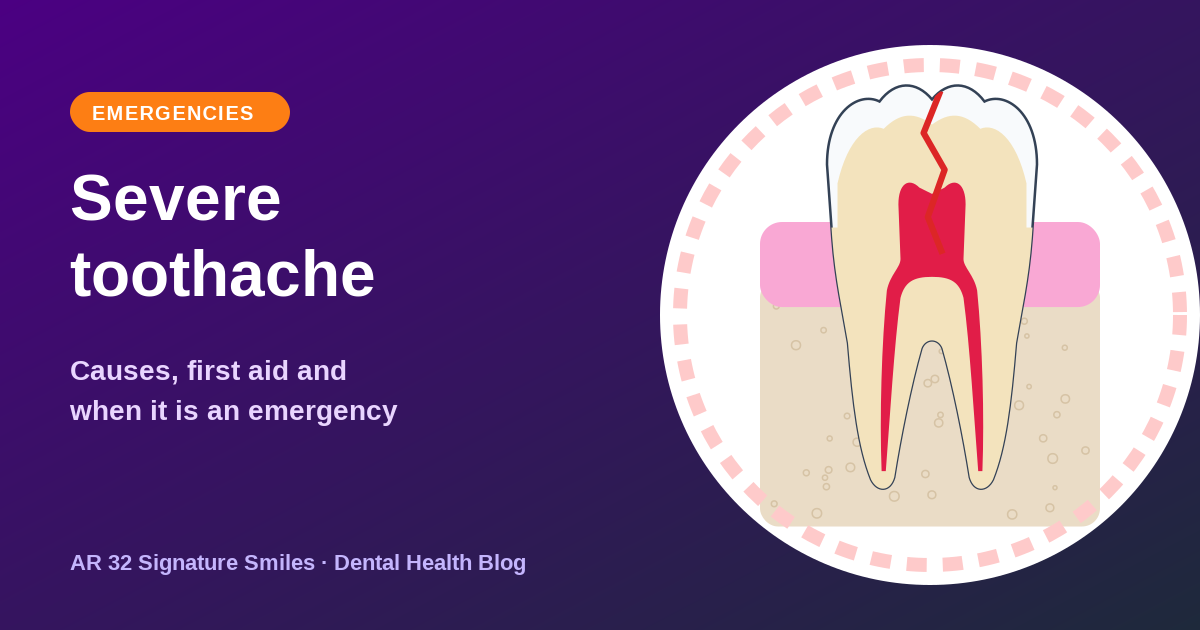
Severe toothache usually means an inflamed nerve or an infection. The common dental and non-dental causes, what to do straight away, which signs mean hospital now, what the dentist will do, and why antibiotics alone do not fix it.
Contents
A severe toothache is intense pain in or around a tooth, often throbbing, often worse at night, and sometimes spreading to the ear, temple or jaw. It is almost always a sign that the nerve inside a tooth is inflamed or that infection has reached the bone around it. Painkillers can bring relief for a few hours, but the cause needs dental treatment. A toothache with spreading facial swelling, fever or difficulty swallowing or breathing is an emergency.
Go to a hospital emergency department now if you have swelling of the face spreading towards the eye or down the neck, difficulty swallowing, breathing or opening your mouth, a high temperature with a swollen face, or if jaw pain comes with chest pain, breathlessness or sweating.
Common causes
Irreversible pulpitis
Deep decay or a crack lets bacteria reach the pulp. The inflamed pulp is trapped inside rigid walls, so pressure rises. The pain is typically sharp or throbbing, triggered by hot or cold and lingering after the stimulus is gone, or coming on spontaneously. It often keeps people awake, and can be hard to locate — it may feel as if it is in the wrong tooth or the other jaw. Treatment is root canal treatment or extraction.
Dental abscess
When the pulp dies, infection spreads out of the root tip into the bone. The tooth becomes very tender to bite on and may feel "high"; the gum may swell, and a gum boil or facial swelling may appear. Hot drinks may make it worse and cold may give brief relief. Treatment drains the infection: root canal treatment, extraction, or incision of a swelling.
Cracked tooth
Sharp pain when biting, especially when releasing the bite, and sometimes to cold. Often difficult to see on an X-ray.
Pericoronitis
Inflammation of the gum over a partly erupted wisdom tooth. Pain at the back of the mouth, swelling, a bad taste and sometimes difficulty opening the mouth.
Dry socket
Severe, throbbing pain beginning two to four days after a tooth extraction, when the blood clot has been lost from the socket. See tooth extraction.
Gum (periodontal) abscess
A painful swelling beside a tooth affected by gum disease, sometimes with pus.
Pain that is not from a tooth
- Sinusitis — aching in several upper back teeth, worse on bending forward, often with a blocked nose.
- Jaw joint and muscle pain — aching in front of the ear and in the jaw muscles, often from clenching or grinding.
- Nerve pain such as trigeminal neuralgia — brief, electric-shock pains triggered by touching the face.
- Heart pain — angina or a heart attack can occasionally be felt in the lower jaw. Jaw pain with exertion, chest discomfort or breathlessness needs urgent medical attention.
What to do now
- Take a suitable painkiller. Paracetamol or ibuprofen, at the dose on the pack, are usually the most useful. Ibuprofen is not suitable for everyone — for example people with stomach ulcers, some kidney or heart conditions, some people with asthma, or in pregnancy — so check with a pharmacist or doctor if unsure. Do not exceed the stated dose.
- Never put an aspirin tablet on the gum next to the tooth. It burns the gum and does not help the tooth.
- For swelling, hold a cold pack wrapped in a cloth against the cheek for short periods. Do not apply heat to a swollen face.
- Keep your head raised at night with an extra pillow; lying flat can increase throbbing.
- Avoid very hot, cold or sweet food and chew on the other side.
- Rinse gently with warm salt water if food is caught or the gum is sore.
- Call a dentist to be seen as soon as possible — the same or next day for severe pain.
What the dentist will do
The dentist asks about the pain, examines the teeth and gums, tests the suspect tooth with cold and tapping, and takes an X-ray. The aim is to find the source and remove it. Depending on the cause, this may be:
- Removing decay and placing a sedative filling, if the pulp can recover.
- Starting root canal treatment — removing the inflamed pulp usually relieves pain quickly.
- Draining an abscess.
- Extracting the tooth.
- Cleaning and dressing a dry socket, or cleaning under a gum flap.
Antibiotics and toothache
Antibiotics do not cure toothache. Pulpitis is inflammation inside a closed tooth, which antibiotics cannot reach; an abscess needs its source removed. Antibiotics are used alongside treatment when infection is spreading, there is fever or significant swelling, or the patient has particular medical risks. Taking them on their own usually leads to the pain returning, and unnecessary use contributes to antibiotic resistance.
Prevention
Most severe toothaches are the late stage of problems that could have been caught earlier — decay, cracked fillings, gum disease, troublesome wisdom teeth. Regular check-ups, fluoride toothpaste, less frequent sugar and prompt attention to sensitivity are the best prevention. See tooth decay.
Common myths
"If the pain goes away, the problem is solved." Pain often stops when the nerve dies. The infection then continues silently and can flare up later.
"Clove oil or home remedies will fix it." Clove oil can numb briefly; it does not treat the cause.
"A swollen tooth can't be treated until the swelling goes down." Often the quickest way to reduce swelling is to drain the infection by treating or removing the tooth.
Emergency care at AR 32
Call reception on 8484990678 and say that you are in pain, so the appointment can be prioritised. See our emergency dentist page and our tooth pain questions.
Key terms
- Abscess
- A collection of pus from a bacterial infection.
- Pericoronitis
- Inflammation of the gum around a partly erupted tooth.
- Pulpitis
- Inflammation of the nerve and blood vessels inside the tooth.
- Referred pain
- Pain felt in a place other than its source.
Frequently asked questions
Why is toothache worse at night?
Lying down increases blood pressure in the head, which raises pressure in the inflamed pulp, and there are fewer distractions. Keeping the head raised can help.
Can I take paracetamol and ibuprofen together?
Many adults can use them together or alternately, within each one's maximum dose. Ask a pharmacist or doctor if you have any medical conditions or take other medicines.
Should I go to the hospital for toothache?
Not for toothache alone. Go to hospital for spreading swelling, fever, difficulty swallowing, breathing or opening the mouth.
Further reading
- NHS. Toothache.
- On this site: Root canal treatment · Emergency dentist