Menu

Around Kharadi

411014411036411006

Wagholi side

412207411047411015

Hadapsar side

411028411013

Everywhere else

All areas we serve

is it better to save a tooth or remove it

By Dr Mayank Patil (MDS, Oral & Maxillofacial Surgery) · Last reviewed 23 October 2026 · 506 words

The short answer

If the tooth has enough healthy structure, firm bone support and no crack through the root, saving it is usually better than removing it, because your own root keeps the bone and bite stable. Removal is the wiser choice when a tooth cannot be restored reliably, keeps failing, or is a wisdom tooth with no function.

There is no single right answer for every tooth. Saving a tooth is generally the better default, but not at any price and not for every tooth. A good decision weighs how restorable the tooth is, how important it is in your mouth, and what you would replace it with.

Why keeping your own tooth usually wins

  • A natural root keeps the jawbone around it. Once a tooth is lost, the bone in that area slowly shrinks.
  • Your own tooth has a ligament around the root that gives you a fine sense of biting pressure. Implants do not have this.
  • A saved tooth keeps the neighbours and opposing tooth in place.
  • Even the best replacement is a replacement. It needs its own maintenance and can fail.

A decision checklist

Your dentist will look at these, usually with an X-ray:

  1. Is there enough tooth above the gum? A crown needs sound tooth to grip. If decay has gone well below the gum line, saving it may need extra procedures and becomes less predictable.
  2. Is the root cracked? A vertical crack running down the root generally means the tooth cannot be saved, however good the root canal.
  3. How much bone is holding it? A tooth that is very loose from advanced gum disease may not be worth heavy investment.
  4. Has treatment already failed? A first root canal has a good outlook. A second attempt on a tooth with a poor history is a closer call.
  5. How important is this tooth? A first molar or a front tooth matters more than a wisdom tooth.
  6. What is your health and budget? Both are legitimate parts of the decision.

Comparing costs honestly

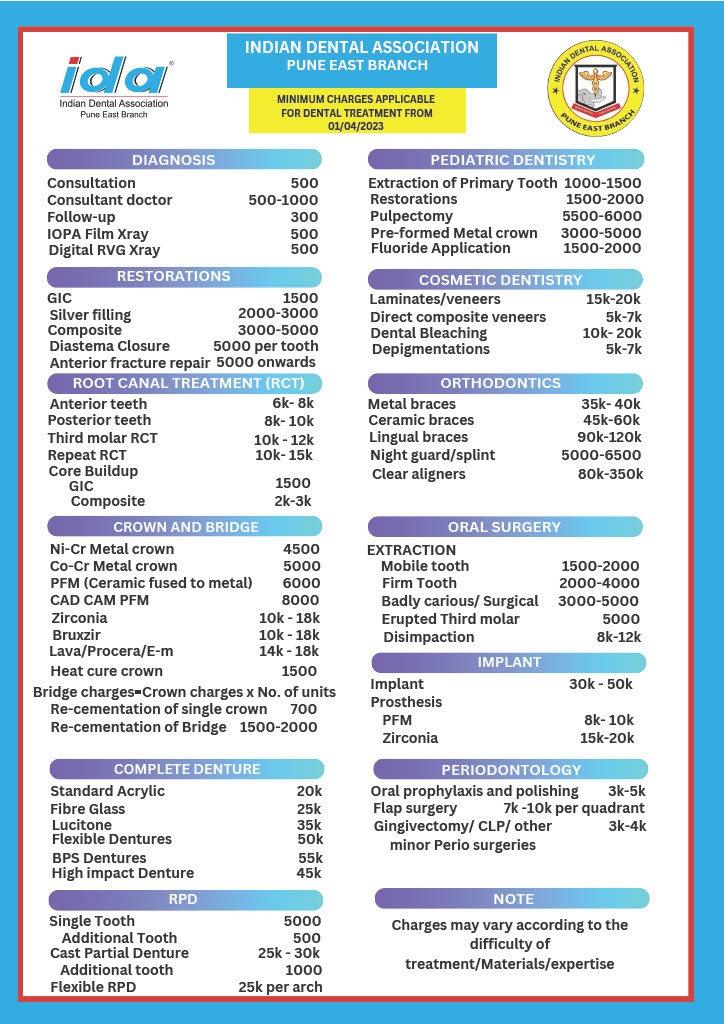
Using our current published fees: saving a molar might mean a root canal treatment at ₹9,000, a core build-up at ₹3,000 and a crown from ₹3,000 for metal up to ₹12,000 for zirconia. Removing it is ₹1,000 to ₹4,000 depending on difficulty, but if you then replace it with an implant, our published fee is from ₹80,000. Final costs are confirmed after examination; you can see the list on our online store.

So saving is usually cheaper over time if you plan to replace the tooth. If you would not replace it, for example a back molar with nothing opposite it, extraction alone can be a reasonable and economical choice. We will say so when that is the case.

When removing is the better call

  • The tooth is unrestorable or the root is fractured.
  • Repeated infections despite proper treatment.
  • An impacted or decayed wisdom tooth causing problems.
  • Extraction is part of an orthodontic plan.
  • Keeping a very weak tooth would put the success of a larger plan at risk.

Getting the right opinion

Your dentist examines the tooth first and, where the decision is close, involves a specialist from our endodontics department to judge whether the root can be treated predictably. The what treatment do I need tool helps you think through the options before your visit, and you can book a consultation to have the tooth assessed.

Answered by Dr Mayank Patil, MDS — Department of Oral & Maxillofacial Surgery, AR 32 MDS panel
Reviewed and approved by Dr Avinash Bamane, BDS — registration A-18814
Last reviewed 23 October 2026 · next review due October 2027
This answers a general question. It is not a diagnosis, and it cannot account for what is actually happening in your mouth. If something hurts, get it looked at — by us or by anyone.

Want this looked at properly?

Kharadi runs late. Reception will tell you honestly whether you need an appointment yet.

Book — Rs 500 ☎ 8484990678
Related questions

how much does a tooth extraction cost is extraction safe if i take blood thinners does a tooth extraction hurt do i need antibiotics after a tooth extraction when should i replace an extracted tooth All tooth extraction questions →