Dental implants
A dental implant is a titanium root placed in the jaw bone to carry a replacement tooth. What implants are made of, how bone fuses to them, who can have them, planning, each stage of treatment, bone grafting, success, risks, peri-implantitis and the alternatives.
Contents
A dental implant is an artificial tooth root, usually a small screw of titanium, placed in the jaw bone to replace a missing tooth. Once the bone has grown tightly onto its surface — a process called osseointegration — the implant can carry a crown, a bridge or a denture. Implants are the closest thing dentistry has to growing a new tooth: they are fixed, they do not rely on the neighbouring teeth, and with good care they last for many years.
The modern implant grew out of research in the 1950s and 1960s by the Swedish surgeon Per-Ingvar Brånemark, who found that bone would bond directly to titanium. The first patient was treated in 1965. Since then implants have become a routine way of replacing teeth, and they are among the most thoroughly studied treatments in dentistry.
What an implant is made of
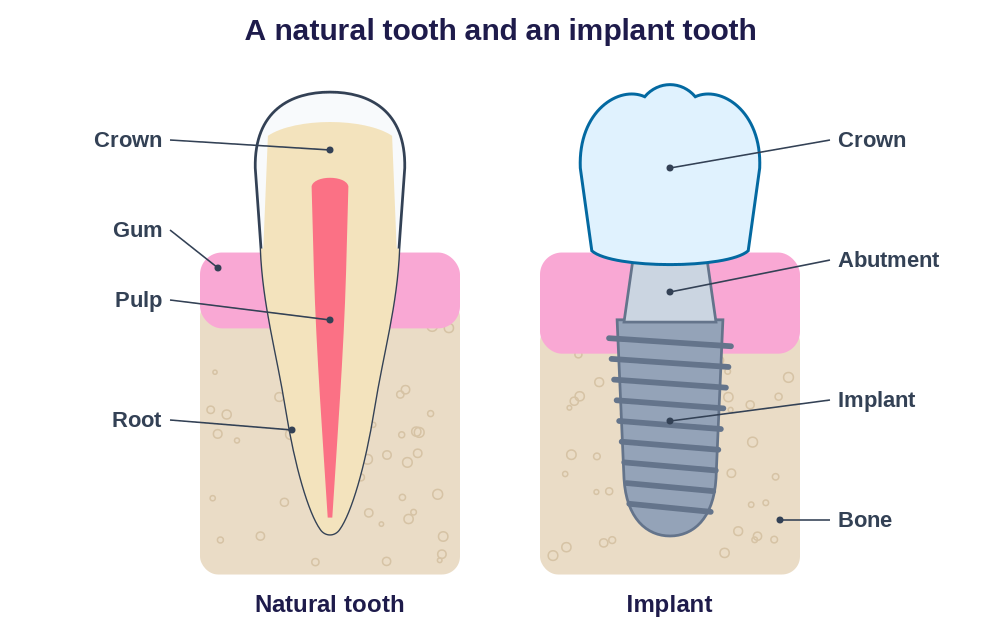
An implant tooth has three parts:
- The implant, or fixture — the screw-shaped root that sits in the bone. Most are made of commercially pure titanium or a titanium alloy, with a roughened surface that bone grows onto more readily. Ceramic (zirconia) implants exist for particular situations.
- The abutment — a connector screwed into the top of the implant. It passes through the gum and holds the crown.
- The restoration — the crown, bridge or denture. Crowns are made of ceramic such as zirconia, or porcelain bonded to metal, and are either cemented onto the abutment or screwed through it.
There is an important difference from a natural tooth. A natural root is suspended in its socket by the periodontal ligament, which cushions it and gives a sense of touch. An implant is fused directly to bone and has no ligament. It does not move at all, and it cannot get decay — but the gum and bone around it can still become diseased.
Osseointegration
When an implant is placed, the bone around it is injured by the drilling and begins to heal, just as a fracture does. Over weeks, new bone forms against the implant surface and locks onto it. At first the implant is held mainly by its mechanical grip in the bone (primary stability); as the bone remodels, that grip is replaced by biological bonding (secondary stability). The implant is usually ready to carry a permanent tooth after about two to four months in the lower jaw and three to six months in the upper jaw, where the bone is softer — though this varies with each patient and each site.
Uses
- Single tooth — one implant and one crown, leaving the neighbouring teeth untouched.
- Several teeth — two or more implants supporting a bridge, so that, for example, three missing teeth may be replaced with two implants.
- Full arch — a fixed bridge of ten to fourteen teeth on typically four to six implants, for people who have lost all their teeth in a jaw, or will.
- Implant overdenture — a removable denture that clips onto two or more implants, transforming the stability of a loose lower denture.
Who can have implants
Most adults who have lost teeth can have implants. Age by itself is not a barrier, but the jaw must have stopped growing, so implants are generally not placed until the late teens or early twenties. A good candidate has:
- Enough bone of good quality at the site, or bone that can be built up.
- Healthy gums, with any gum disease treated and controlled first.
- General health that allows minor oral surgery.
- The willingness to clean the implant carefully and attend maintenance visits.
Things that raise the risk
- Smoking — the most consistent risk factor for implant failure and for peri-implantitis.
- Uncontrolled diabetes — well-controlled diabetes is usually compatible with implants; poor control slows healing and raises infection risk.
- A history of periodontitis — increases the risk of disease around implants, so the gums must be stable first.
- Radiotherapy to the jaws, and bone-modifying medicines (such as bisphosphonates and denosumab), especially in high doses for cancer, which carry a risk of jaw bone problems after surgery.
- Heavy grinding or clenching, which overloads implants and crowns.
- Some conditions affecting immunity or bone healing.
None of these is automatically a bar, but each must be discussed and managed before treatment.
Planning
Implant treatment is planned backwards from the tooth: first where the final crown should be, then where the implant must go to support it. Planning includes:
- A full examination of the mouth, gums and bite, and a medical history.
- X-rays and, for most implant sites, a cone-beam CT (CBCT) scan, which shows the height, width and density of the bone in three dimensions and the position of the nerve in the lower jaw and the sinus in the upper jaw.
- Impressions or digital scans of the teeth, and sometimes a surgical guide made from them to place the implant precisely.
- A discussion of the options, the number of stages, the time involved and the cost.
The procedure
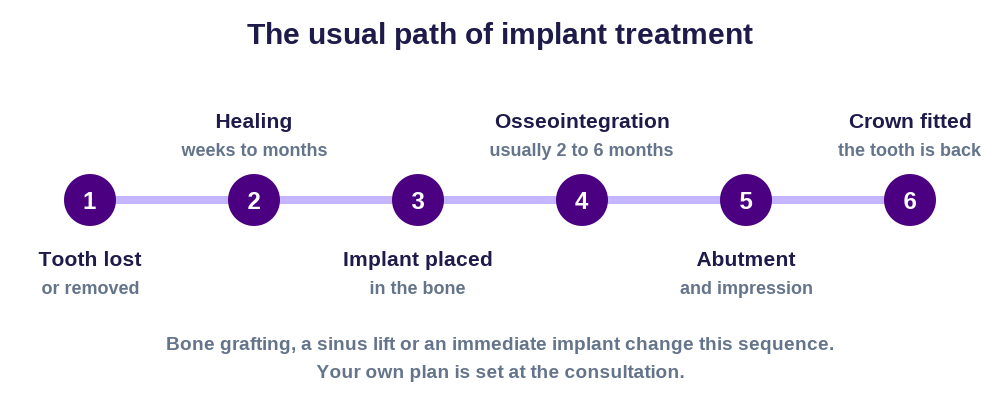
- Extraction and healing. If the tooth is still present it is removed, as gently as possible to preserve bone. The socket is usually left to heal for a few weeks to a few months, sometimes with a graft placed in it to keep its shape (socket preservation).
- Placing the implant. Under local anaesthetic, the gum is opened (or a small circle of gum removed), a precise hole is prepared in the bone with a sequence of drills at slow speed under cooling, and the implant is screwed in. A healing cap or a cover screw is placed and the gum stitched. Most people find this easier than they expect; it is often compared to having a tooth out.
- Osseointegration. The bone heals onto the implant over the following months. A temporary tooth or denture can usually be worn in the meantime, and in the front of the mouth a temporary crown is sometimes fixed to the implant straight away.
- Uncovering and the abutment. If the implant was buried, it is uncovered and a healing abutment fitted so the gum forms a natural collar. Impressions or scans are then taken.
- The final tooth. The abutment and crown (or bridge) are fitted and the bite adjusted.
Immediate implants and immediate loading
In suitable cases an implant can be placed into the socket on the same day the tooth is removed (immediate placement), and sometimes a temporary tooth fixed onto it at once (immediate loading). These approaches shorten treatment but need good bone, no active infection and a stable implant, and they are chosen case by case.
When there is not enough bone
After a tooth is lost, the bone that held it shrinks, fastest in the first months. Where the bone is too thin or too short:
- Bone grafting adds bone, from the patient or from a graft material, either before the implant or at the same time. See bone graft.
- A sinus lift raises the floor of the maxillary sinus to make room for an implant in the upper back jaw.
- Shorter or narrower implants, or angled implants in full-arch treatment, can sometimes avoid grafting.
Recovery
After placement it is normal to have some swelling, mild bruising and tenderness for a few days, best managed with cold packs on the first day and the painkillers your dentist advises. Antiseptic mouthwash is often recommended. For the first week or two, eat soft food on the other side, avoid smoking entirely, and keep the area clean as instructed. Stitches, if they do not dissolve, are removed after about a week.
Success and how long implants last
Implants are highly reliable. A 2019 systematic review by Howe and colleagues, which pooled studies following implants for ten years, found that well over nine in ten were still in place at the end. Long-term success depends less on the implant itself than on the patient's health, smoking, cleaning and maintenance, and on how well the treatment was planned. The crown on an implant may need replacing after some years from wear or chipping, just as crowns on natural teeth do.
Risks and complications
- Early failure — the implant does not integrate and becomes loose, usually in the first weeks or months. It is removed, the site heals, and another implant can often be placed later.
- Infection after surgery.
- Nerve injury — in the lower jaw, an implant too close to the inferior alveolar nerve can cause numbness or altered sensation of the lip and chin, sometimes permanent. Careful 3D planning keeps this risk low.
- Sinus perforation in the upper jaw.
- Mechanical problems — loosening of the abutment screw, chipping of the crown, or rarely fracture of the implant.
- Peri-implant mucositis and peri-implantitis — see below.
- Appearance — in the front of the mouth, gum recession or thin tissue can expose a grey margin, which careful planning tries to prevent.
Peri-implantitis
Plaque collects on implants as it does on teeth. Inflammation of the gum around an implant without bone loss is peri-implant mucositis, and like gingivitis it is reversible. If it progresses to bone loss around the implant it is peri-implantitis, which is harder to treat than gum disease around natural teeth and can lead to the loss of the implant. Smoking, a history of periodontitis, poor cleaning and missing maintenance visits are the main risks. This is why implant treatment does not end when the crown goes in: daily cleaning and regular professional review are part of it. Read about the related disease in our article on gum disease.
Alternatives
| Option | Advantages | Disadvantages |
|---|---|---|
| Implant and crown | Fixed; neighbouring teeth untouched; helps preserve bone; long-lasting | Surgery; takes months; needs adequate bone and health; higher initial cost |
| Fixed bridge | Fixed; quicker; no surgery | Neighbouring teeth are trimmed for crowns; cleaning under the bridge is harder; if one supporting tooth fails the bridge may be lost |
| Resin-bonded bridge | Minimal trimming of neighbours | Suitable for limited situations, mainly front teeth; can come unstuck |
| Removable partial denture | Least invasive; lower cost; replaces many teeth at once | Removable; less stable; can trap plaque against the remaining teeth |
| Complete denture | Replaces all teeth in a jaw without surgery | Lower dentures in particular can be loose; chewing efficiency is reduced |
| Leaving the gap | No treatment | Neighbouring teeth may tip and opposing teeth over-erupt; bone shrinks; appearance |
When the natural tooth can still be saved, keeping it — for example with root canal treatment and a crown — is usually the first option to consider. Implants are excellent replacements for teeth that cannot be saved, not a reason to remove teeth that can.
Caring for implants
- Brush twice a day around the implant crown, angling the brush to the gum line.
- Clean between the teeth and around the implant daily with interdental brushes, floss designed for implants, or a water flosser.
- Do not smoke.
- Wear a night guard if you grind your teeth.
- Attend maintenance visits so that the gum and bone around the implant can be checked and any problem caught early.
Common myths
"Implants are permanent and need no care." The implant cannot decay, but the gum and bone around it can be lost to infection. Implants need as much cleaning as teeth, if not more.
"I'm too old for implants." Healthy older adults have implants successfully. Health and bone matter far more than age.
"The body rejects implants." Titanium does not provoke an immune rejection the way a transplanted organ can. Failures are caused by infection, overload or poor healing, not rejection; true titanium allergy is very rare.
"Implants hurt more than extraction." Most people report that placing an implant is similar to, or easier than, having a tooth removed.
What affects the cost
The fee depends on the number of implants, the implant system, the type of crown or bridge, whether bone grafting or a sinus lift is needed, imaging, and the number of temporary teeth required along the way. Because so much depends on the bone at your own site, a written plan is given after examination and imaging. Our current fees are listed in the treatment guide.
Dental implants at AR 32
Implant treatment at our clinics is planned after an examination and imaging, and placed with specialists from our MDS panel where the case needs them, including oral surgeons and periodontists for grafting and complex sites. Read about the treatment on our dental implant page, other ways of replacing missing teeth, and quick answers in our implant questions.
Key terms
- Abutment
- The connector between the implant and the crown.
- Bone graft
- Bone or a bone substitute added to rebuild the jaw where it is too thin or short.
- CBCT
- Cone-beam computed tomography; a 3D X-ray used to plan implants.
- Fixture
- The implant body that sits in the bone.
- Immediate loading
- Fixing a tooth to an implant on the day it is placed.
- Osseointegration
- The direct structural bond between living bone and the implant surface.
- Peri-implantitis
- Inflammation around an implant with loss of the supporting bone.
- Sinus lift
- Raising the floor of the maxillary sinus to make space for an implant.
Frequently asked questions
How long does implant treatment take?
From placement to the final tooth, usually three to six months. Add healing time if a tooth must be removed first, and longer if bone grafting is needed. Immediate options can shorten it in suitable cases.
Will I be without a tooth while it heals?
Usually not. A temporary denture, a bonded temporary tooth or, in some cases, a temporary crown on the implant can be worn.
Can an implant be placed the same day a tooth is removed?
Sometimes, when there is no active infection and the bone allows a stable implant. Your dentist will advise after imaging.
Can people with diabetes have implants?
Yes, if the diabetes is well controlled. Healing may be monitored more closely.
Do implants set off airport metal detectors or affect MRI scans?
Dental implants are too small to trigger airport detectors. They are generally safe in MRI scanners, though they can affect the image near the jaw; tell the radiographer you have them.
Further reading
- Howe MS, Keys W, Richards D. Long-term (10-year) dental implant survival: a systematic review and sensitivity meta-analysis. Journal of Dentistry, 2019. PubMed 30904559.
- NHS. Dental treatments.
- On this site: Dental implants at AR 32 · Missing tooth replacement · Gum disease


