Dental crowns
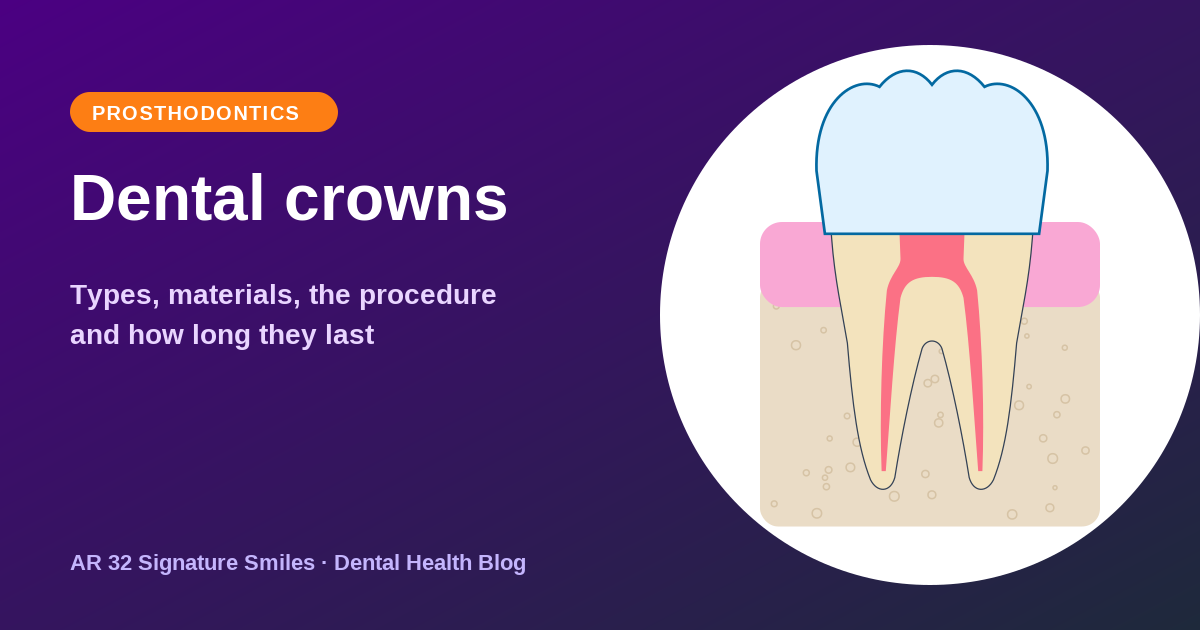
A dental crown is a made-to-measure cap that covers a weakened, broken or discoloured tooth. When a crown is needed, the materials compared, each step of the procedure, aftercare, lifespan, problems and the alternatives.
Contents
A dental crown is a cap that covers the whole visible part of a tooth, restoring its shape, strength and appearance. Crowns are used when a tooth is too broken down, weakened or discoloured to be repaired reliably with a filling: after root canal treatment, after a large filling fails, when a tooth cracks, or to support a bridge. The crown is made to measure, usually in a dental laboratory, and cemented permanently onto the prepared tooth.
Crowns are among the oldest restorations in dentistry. Gold crowns were used in the nineteenth century, porcelain jacket crowns arrived in the early twentieth, and porcelain fused to metal became standard from the 1960s. Today most crowns placed on visible teeth are metal-free ceramics, and many are designed on a computer and milled from a solid block.
When a crown is needed
A filling relies on the walls of the tooth around it for strength. Once too much of the tooth has been lost, those walls are thin and the tooth is likely to split under chewing forces. A crown wraps around the remaining tooth and holds it together. Common reasons are:
- After root canal treatment of a back tooth, which has usually lost a great deal of structure and is prone to fracture. See root canal treatment.
- A large or failing filling where little natural tooth is left.
- A cracked tooth, to stop the crack spreading.
- Severe wear from grinding or erosion, where teeth have become short.
- Badly discoloured or misshapen teeth that cannot be improved more conservatively.
- To carry a bridge, where crowns on the teeth either side support a false tooth.
- On a dental implant, where the crown is the visible tooth. See dental implants.
A crown is not automatically the answer to every damaged tooth. Preparing a tooth for a crown removes healthy tissue, so where an onlay or a bonded filling would do the job, those are kinder to the tooth.
Types of crown
| Type | Strengths | Limitations | Typical use |
|---|---|---|---|
| Full metal (cast alloy) | Very strong, needs the least tooth removed, kind to opposing teeth | Metallic colour | Back molars out of sight, heavy grinders |
| Porcelain fused to metal (PFM) | Long track record, strong, tooth-coloured outside | Porcelain can chip; a grey line can show at the gum; more tooth removed | Back teeth and bridges |
| Zirconia | Very strong, metal-free, can be made thin | Solid (monolithic) zirconia is less translucent than glass-ceramic | Back teeth, bridges, implant crowns |
| Layered or high-translucency zirconia | Better appearance than solid zirconia, still strong | The outer porcelain layer can chip | Teeth that show when smiling |
| Glass-ceramic (lithium disilicate) | Most natural translucency, bonds to tooth | Less strong than zirconia for long bridges | Front teeth, premolars |
| Temporary (acrylic or composite) | Quick, protects the tooth while the final crown is made | Not durable | Between visits |
The right material depends on where the tooth is, how heavily you bite, how much of the crown will show, the colour of the tooth underneath, and how much space there is. There is no single best crown for every tooth.
The procedure
- Assessment. The tooth is examined and X-rayed to check that the nerve is healthy or has been treated, that there is no decay left underneath, and that the gum and bone are sound. A shade is chosen in good light.
- Core build-up. If much of the tooth is missing, it is first rebuilt with a filling material (a core) so the crown has something solid to sit on. After root canal treatment, a post may occasionally be added to help retain it.
- Preparation. Under local anaesthetic, a layer of tooth is shaped away all round so that the crown can fit over it without being bulky. The amount removed depends on the material: metal needs the least, porcelain on metal the most.
- Impression or scan. An accurate record of the prepared tooth and its neighbours is taken, with a putty impression or a digital intraoral scan, along with a record of the bite.
- Temporary crown. A temporary crown is cemented with a soft cement to protect the tooth, keep it comfortable and stop neighbouring teeth drifting.
- Fitting. At the second visit the temporary is removed, the final crown is tried in, checked for fit, contact with neighbours, bite and colour, and then cemented or bonded permanently.
After the crown is fitted
Some sensitivity to cold for a few days is common, especially on a tooth that still has its nerve. The bite should feel normal; if the crown feels high or you notice pain on biting after the anaesthetic wears off, it needs a small adjustment. Look after a crown as you would a natural tooth: brush twice a day with fluoride toothpaste and clean between the teeth daily, paying attention to the margin where the crown meets the tooth.
The crown itself cannot decay, but the tooth underneath can, starting at the edge. Decay at the margin is one of the commonest reasons crowns eventually fail.
How long crowns last
Well-made crowns commonly last ten to fifteen years and often much longer. Their lifespan depends less on the material than on the health of the tooth underneath, the quality of the fit, how heavily you bite or grind, and how well the margins are kept clean.
Risks and problems
- Sensitivity after preparation, usually temporary.
- Pulp damage. Preparing a live tooth stresses its nerve. A small proportion of crowned teeth later need root canal treatment, particularly teeth that were heavily filled before.
- Loosening of the cement, so that the crown comes off. It can often be recemented if the tooth underneath is sound.
- Chipping or fracture of porcelain, more likely in people who grind.
- Recurrent decay at the margin.
- Gum problems around a margin that is overhanging or hard to clean.
- Appearance — a dark line at the gum on some metal-based crowns, or a shade that does not match perfectly.
Alternatives
- Large bonded filling — preserves more tooth; suitable when the walls are still reasonably thick.
- Onlay — a partial crown that covers only the cusps that need protection, preserving more healthy tooth. See onlay.
- Veneer — for front teeth where the concern is mainly appearance.
- Extraction and replacement — when the tooth cannot be restored.
Common myths
"A crowned tooth can never get a cavity." The tooth under the crown can decay at the edge. Cleaning at the gum line matters as much as ever.
"All-white crowns are always better." Metal-free crowns look better on visible teeth, but on a back molar of a heavy grinder a metal or solid zirconia crown may last longer.
"Crowns are only cosmetic." Most crowns on back teeth are placed to stop a weakened tooth from splitting.
What affects the cost
The material, the laboratory, whether a core build-up or post is needed, any root canal treatment beforehand, and whether a temporary crown is required. Our current fees for each type of crown are listed in the treatment guide.
Crowns at AR 32
Our clinics offer temporary crowns, metal crowns, porcelain-fused-to-metal crowns, zirconia crowns and a higher-aesthetic zirconia option for visible teeth. Complex cases involving several crowns or a change in the bite are planned with a prosthodontist from our MDS panel. See crowns and bridges, zirconia crowns and PFM crowns, and quick answers in our crown questions.
Key terms
- Abutment
- A tooth or implant that supports a crown or bridge.
- Core
- A filling that rebuilds a broken-down tooth before it is crowned.
- Margin
- The edge where the crown meets the tooth.
- Monolithic
- Made from a single material throughout, with no layered porcelain.
- Onlay
- A partial crown covering one or more cusps.
- Preparation
- Shaping the tooth so a crown can fit over it.
Frequently asked questions
Does getting a crown hurt?
The tooth is numbed for preparation, so it should not. Mild sensitivity for a few days afterwards is common.
Can I eat normally with a temporary crown?
Eat carefully on the other side, and avoid sticky or very hard food. Temporary crowns are held with weak cement on purpose.
What if my crown comes off?
Keep it, and call the clinic. If the tooth is not broken and has no new decay, the crown can often be cleaned and recemented.
Will a crown match my other teeth?
The shade is chosen to match. If you plan to whiten your teeth, do it before the crown is made, because crowns do not change colour with whitening.
Further reading
- On this site: Crowns and bridges · Root canal treatment · Dental implants


