why does my crown feel high when i bite
A crown usually feels high because it touches the opposite tooth slightly before your other teeth do. This is common, since the bite is hard to judge while your mouth is still numb. Do not wait for it to settle: a high crown can make the tooth sore, inflame the ligament around it and even crack it. A quick adjustment visit usually fixes it in minutes.
You leave the clinic happy, the numbness wears off over dinner, and when you close your teeth together the new crown meets first. Sometimes it is a tiny bump only you notice; sometimes chewing on that side hurts. Either way it is worth getting checked.
Why it happens
- Numbness during fitting. When your lips, tongue and jaw are numb, you cannot feel your bite accurately, and you tend to close differently. The bite marks checked in the chair can be slightly off.
- Lying back in the chair. Your jaw sits a little differently when you are reclined than when you sit up and eat.
- Cement thickness. The thin layer of cement can lift the crown very slightly when it is seated.
- Tooth movement under the temporary. If the temporary was worn or lost, the opposite tooth may have moved down a little, so the new crown now meets it early.
- Sore ligament. The tooth sits in a cushion of fibres called the periodontal ligament. After the preparation and fitting, this can be bruised and slightly swollen, which pushes the tooth up a fraction and makes even a perfect crown feel high for a day or two.
Why you should not just "get used to it"
Many people wait, hoping the feeling will pass. A slightly high crown takes the full force of every bite, hundreds of times a day. Over a week or two this can cause:
- Pain on biting and tenderness when you tap the tooth.
- Inflammation of the ligament, so the tooth feels loose or "long".
- Sensitivity to cold, and in a living tooth, irritation of the nerve, sometimes leading to a root canal.
- Chipping of the porcelain, or a crack in the tooth or the opposite tooth.
- Aching jaw muscles or jaw joint, as your bite shifts to avoid the high spot.
What the adjustment involves
The adjustment is quick and usually painless. Your dentist asks you to bite and grind on thin coloured articulating paper, which marks the spots that touch too early. Those spots are gently reshaped with a fine bur and then polished smooth, checking again until your bite feels even on both sides. A good polish afterwards matters, especially on zirconia, so the surface does not wear the opposite tooth. No anaesthetic is normally needed.
When "high" is not actually the bite
If adjustment does not help, or the pain has other features, your dentist will look further:
- Lingering pain after hot or cold, or night pain: the nerve may be inflamed.
- Sharp pain on biting at one particular angle: there may be a crack in the tooth.
- Swelling or a gum boil: there may be infection.
- Pressure between teeth and food trapping: a contact may be too tight or too open.
A digital X-ray and simple tests usually sort out which it is.
What you can do meanwhile
Chew on the other side, avoid hard foods like supari and nuts, and take a painkiller that suits you if needed. Call the clinic and ask for a short bite-check. It is part of getting the crown right, and you should not feel awkward asking.
If jaw pain is part of the picture, our page on jaw joint pain may help. You can book a check online, and more crown questions are answered on the crowns and bridges hub.
Want this looked at properly?
Kharadi runs late. Reception will tell you honestly whether you need an appointment yet.
Book — Rs 500 ☎ 8484990678Related questions
Read the full guide
Complete articles from our dental health blog, written by our MDS panel.
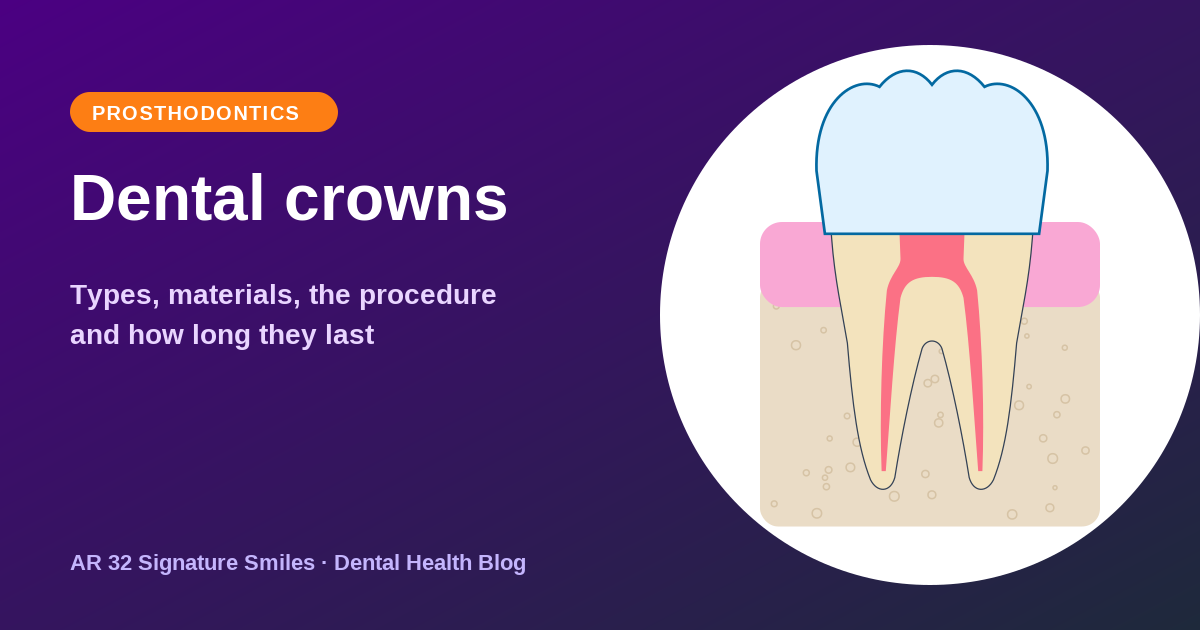 Crowns, bridges and denturesDental crowns7 min read
 Teeth: anatomy and scienceTooth anatomy5 min read
 Oral health and general healthDiabetes and oral health5 min read