Gum disease (gingivitis and periodontitis)
Gum disease is inflammation of the tissues that hold the teeth, caused by plaque. Gingivitis is reversible; periodontitis destroys bone and loosens teeth. Causes, warning signs, how pockets are measured, staging, treatment, the link with diabetes, and prevention.
Contents
Gum disease is inflammation of the tissues that surround and support the teeth, caused by bacterial plaque. Its mild, reversible form is gingivitis: red, swollen gums that bleed when brushed. Its destructive form is periodontitis, in which the inflammation breaks down the ligament and bone holding the teeth, so that pockets form, gums recede and teeth eventually loosen. Periodontitis is the commonest cause of tooth loss in adults, and severe periodontitis affects roughly one adult in five worldwide.
Gum disease is easy to ignore. It rarely hurts, it develops over years, and bleeding gums are so common that many people assume they are normal. They are not: healthy gums do not bleed. Because the bone lost in periodontitis does not grow back by itself, the most valuable thing anyone can do is recognise the disease early.
The periodontium: what holds a tooth in place
The word periodontium means "around the tooth". It has four parts:
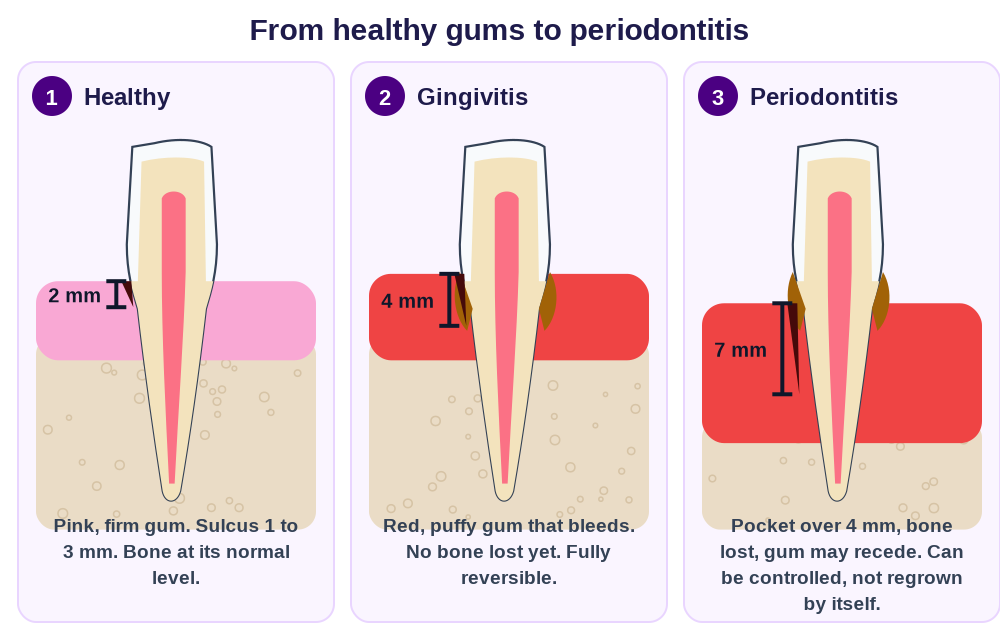
- Gingiva — the gum, the pink tissue that wraps the neck of each tooth. Between the gum and the tooth is a shallow groove, the gingival sulcus, normally 1 to 3 mm deep.
- Periodontal ligament — thousands of fibres connecting the root to the bone, acting as a shock absorber.
- Cementum — a thin layer covering the root, into which the ligament fibres are anchored.
- Alveolar bone — the part of the jaw that forms the tooth sockets.
Periodontitis damages all four. The sulcus deepens into a periodontal pocket, the ligament fibres detach, and the bone around the root is gradually resorbed.
Gingivitis
When plaque is left along the gum line for more than a few days, the gum reacts. It becomes red, puffy and shiny, and bleeds when brushed or flossed. This is gingivitis. It is extremely common and is often painless.
The important fact about gingivitis is that it is fully reversible. No bone has been lost. Once the plaque is removed and kept away by good daily cleaning (and a professional cleaning to remove any hard deposits), the gums return to health, typically within a couple of weeks.
Gingivitis can be made worse by hormonal changes — puberty and particularly pregnancy, when many women notice bleeding gums — by some medicines that cause gum overgrowth, by mouth breathing, and by crooked teeth or poorly fitting fillings that trap plaque.
Periodontitis
In some people, and in some areas of the mouth, long-standing gingivitis progresses. Bacteria spread below the gum line into the sulcus, where a different community of bacteria thrives in the absence of oxygen. The body's immune response to them — rather than the bacteria directly — causes most of the damage: inflammatory chemicals break down the connective tissue and activate the cells that resorb bone.
As attachment is lost, the sulcus deepens into a pocket. A pocket cannot be cleaned with a toothbrush or floss, so more plaque collects and hardens into calculus (tartar) on the root surface, and the cycle continues. Not everyone with gingivitis develops periodontitis; genetics, smoking, diabetes and the particular bacteria present all influence who does.
How periodontitis is classified
Since the 2017 World Workshop of the American Academy of Periodontology and the European Federation of Periodontology, periodontitis is described by its stage and grade:
- Stage I to IV describes severity and complexity — how much attachment and bone have been lost, how many teeth have been lost to the disease, and how complicated treatment will be. Stage I is early; stage IV involves extensive loss with problems in chewing and the bite.
- Grade A, B or C describes how fast the disease is progressing, and takes account of risk factors such as smoking and diabetes. Grade C indicates rapid progression.
The older terms "chronic" and "aggressive" periodontitis are no longer used in the current classification, though you may still see them.
Causes and risk factors
- Plaque. The essential cause. Without bacterial plaque there is no gum disease.
- Smoking and tobacco. The most important modifiable risk factor. Smokers have more bone loss, deeper pockets and respond less well to treatment. Smoking also hides the warning sign, because nicotine narrows the blood vessels and smokers' gums bleed less. Chewing tobacco and gutkha damage the gums where they are held.
- Diabetes. Poorly controlled diabetes increases the risk and severity of periodontitis, and the relationship runs both ways: severe gum inflammation makes blood sugar harder to control.
- Genetics. Some families are much more susceptible than others.
- Stress, poor diet and vitamin C deficiency.
- Medicines that dry the mouth or cause gum overgrowth (some anti-epileptics, calcium-channel blockers for blood pressure, and ciclosporin).
- Conditions that weaken immunity, and hormonal changes.
- Local factors — crowded teeth, overhanging fillings, ill-fitting crowns or dentures that trap plaque.
Signs and symptoms
- Gums that bleed on brushing, flossing or eating, or blood on the pillow.
- Red, swollen or tender gums.
- Bad breath or a bad taste that does not go away. See bad breath.
- Receding gums — teeth looking longer, or dark gaps appearing between them.
- Sensitivity at the necks of the teeth.
- Teeth that feel loose, drift apart or move forward; a change in the way the teeth meet.
- Pus from the gums, or a gum abscess (a painful swelling beside a tooth).
Pain is a late and unreliable sign. Many people with advanced periodontitis have never had a toothache from it.
Diagnosis
Gum disease is diagnosed by measuring it. The key tool is the periodontal probe, a thin blunt instrument marked in millimetres, gently placed into the sulcus at several points around each tooth.
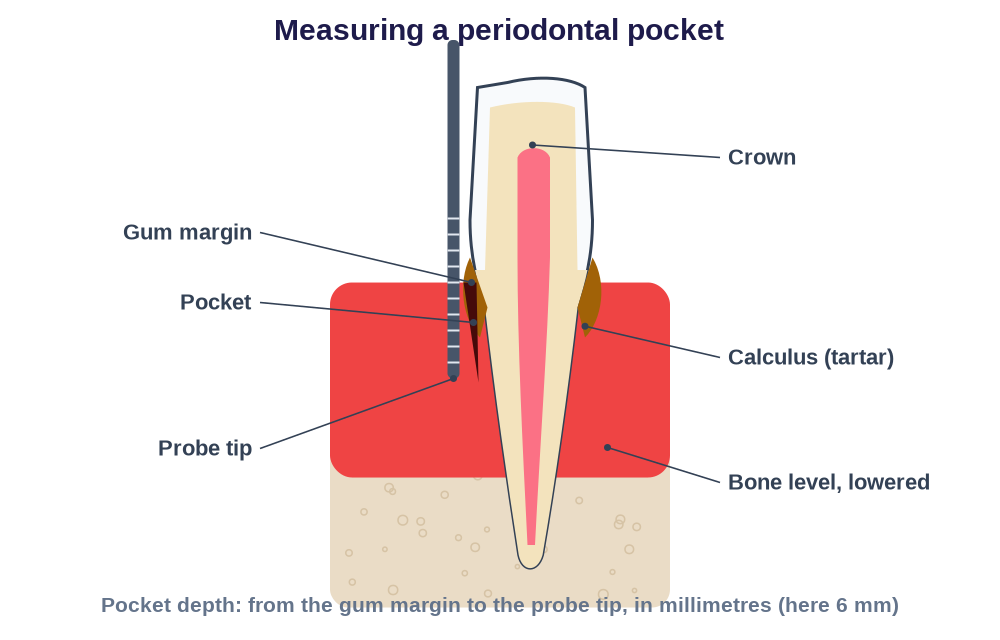
The dentist records:
- Pocket depth — up to 3 mm is normal; 4 to 5 mm suggests disease; 6 mm or more indicates significant periodontitis.
- Bleeding on probing — a sign of active inflammation.
- Recession and clinical attachment loss — how far the attachment has moved down the root.
- Mobility of each tooth, and involvement of the area between the roots of molars (the furcation).
- X-rays to show the level and pattern of bone loss.
A short screening, the Basic Periodontal Examination, is used at routine check-ups to decide whether a full chart is needed. Your medical history, smoking and diabetes status are part of the diagnosis too.
Treatment
Treatment aims to stop the disease, reduce pockets to a depth that can be kept clean, and keep the teeth for life. It is carried out in steps.
- Getting the basics right. Explanation of the disease, personal instruction in brushing and cleaning between the teeth, help with stopping smoking, and attention to diabetes control. Removal of plaque and calculus above the gum line, and correction of fillings or crowns that trap plaque. Nothing else works without this step.
- Cleaning below the gum line. Known as scaling and root planing or subgingival instrumentation. Under local anaesthetic where needed, calculus and bacterial deposits are removed from the root surfaces inside the pockets with ultrasonic and hand instruments. In selected cases, antiseptics or antibiotics are added, but antibiotics alone do not treat periodontitis. See dental scaling.
- Re-evaluation and surgery where needed. After two to three months the gums are measured again. Most shallow and moderate pockets respond. Deep pockets that remain may need flap surgery, in which the gum is lifted so that the roots can be cleaned directly and the bone reshaped. In suitable sites, regenerative procedures use bone grafts or membranes to rebuild some lost support. Recession can be treated with gum grafts. See gum problems.
- Supportive periodontal care. Periodontitis is a chronic condition that can return. Regular maintenance appointments — often every three to six months — to measure, clean and reinforce home care are what keep treated teeth stable over decades.
What treatment can and cannot do. Inflammation can be brought under control and further bone loss stopped. Lost bone does not grow back by itself, though regenerative surgery can rebuild some of it in particular sites. As swelling settles after treatment, gums often shrink slightly and teeth may look longer; this is a sign of healing, not of the disease getting worse.
Loose teeth
Teeth loosened by periodontitis often firm up once inflammation is controlled. Teeth that stay mobile can be splinted to their neighbours. Teeth with very little support left, recurring abscesses or deep furcation involvement may be better removed and replaced, and periodontists help decide which teeth can be kept.
Gum disease and general health
Periodontitis is linked with several conditions elsewhere in the body. The strongest evidence concerns diabetes: treating periodontitis produces a modest improvement in blood-sugar control in people with type 2 diabetes. Associations have also been found with cardiovascular disease, adverse pregnancy outcomes, chronic kidney disease and rheumatoid arthritis. An association is not proof that gum disease causes these conditions, but it is one more reason to treat it. Read more in our section on oral health and general health.
Prevention
- Brush twice a day, angling the bristles towards the gum line, for two minutes.
- Clean between the teeth once a day. Interdental brushes are more effective than floss where the spaces allow them; floss suits tight contacts.
- Stop smoking and using tobacco of any kind.
- Keep diabetes well controlled.
- Have regular check-ups that include a gum assessment, and professional cleaning at the interval your dentist advises.
- Do not ignore bleeding gums. Bleeding is the earliest warning, and it means the gums need more cleaning, not less.
Related conditions
- Necrotising periodontal diseases — a painful, fast-moving infection with ulcerated gums between the teeth, foul breath and sometimes fever, linked with stress, smoking and lowered immunity. It needs prompt treatment.
- Periodontal abscess — a collection of pus in a pocket, causing sudden swelling and pain beside a tooth.
- Peri-implantitis — the equivalent disease around dental implants, which is why a history of periodontitis matters before implant treatment.
- Gum recession without inflammation, often from hard brushing or thin gums.
Common myths
"Bleeding gums are normal." Healthy gums do not bleed when brushed. Bleeding is inflammation.
"If my gums bleed I should brush them less." The opposite: the bleeding comes from plaque left behind. Gentle, thorough cleaning stops it within days or weeks.
"Scaling loosens teeth and wears enamel." Scaling removes the calculus that was hiding bone loss; teeth that feel looser afterwards were already loose. Done correctly it does not damage enamel.
"Losing teeth with age is natural." Teeth are not lost because of age. They are lost to decay and gum disease, both largely preventable.
What affects the cost
The fee depends on the stage of disease: a routine scaling for gingivitis is simple, while advanced periodontitis may need several sessions of deep cleaning under anaesthetic, surgery in some areas, and ongoing maintenance. Our grades of scaling and our gum treatments are listed with their current fees in the treatment guide.
Gum treatment at AR 32
Gum health is assessed at every check-up at our clinics. Scaling is graded according to how much deposit and inflammation there is, and advanced cases, flap surgery and regenerative work are handled with periodontists from our MDS panel. For quick answers, see our gum problem questions.
Key terms
- Calculus
- Hardened, mineralised plaque, also called tartar. It can only be removed professionally.
- Clinical attachment loss
- How far the gum and ligament attachment has moved down the root.
- Furcation
- The area where the roots of a multi-rooted tooth divide.
- Gingival sulcus
- The normal shallow groove between gum and tooth.
- Periodontal pocket
- A sulcus deepened by disease, usually 4 mm or more.
- Periodontist
- A dentist with specialist (MDS) training in gums and the supporting tissues.
- Root planing
- Smoothing and cleaning the root surface inside a pocket.
Frequently asked questions
Can periodontitis be cured?
It can be controlled and stopped, and many people keep their teeth for life after treatment. Because the tendency to the disease remains, it needs ongoing maintenance, much like other chronic conditions.
Is deep cleaning painful?
Local anaesthetic is used where needed, so the cleaning itself should be comfortable. Gums may be tender and teeth sensitive for a few days afterwards.
Will mouthwash cure gum disease?
No. Antiseptic mouthwashes can help in the short term, but they cannot reach into pockets or remove calculus. Mechanical cleaning is the treatment.
Is gum disease contagious?
The bacteria can pass between people, but whether disease develops depends far more on each person's own cleaning, smoking, health and genetics.
Can I have implants if I've had gum disease?
Often yes, once the disease is under control and you are committed to maintenance. A history of periodontitis does raise the risk of problems around implants, so it must be treated first.
Further reading
- Tonetti MS, Greenwell H, Kornman KS. Staging and grading of periodontitis: framework and proposal of a new classification and case definition. Journal of Periodontology, 2018. PubMed 29926952.
- World Health Organization. Oral health fact sheet.
- NHS. Gum disease.
- On this site: Gum problems · Dental scaling · Dental implants


