Gum disease is treated in stages. First comes a thorough professional cleaning (scaling) to remove plaque and tartar, with deeper cleaning below the gumline if pockets have formed. Your daily cleaning is coached and the gums are re-checked after healing. Deep pockets that remain may need gum surgery, and everyone treated for periodontitis then needs regular maintenance visits.
There is no single injection, tablet or mouthwash that cures gum disease. Treatment works by removing the bacteria and tartar that drive the inflammation, then making it hard for them to come back. How much is needed depends on whether you have gingivitis (gums only) or periodontitis (bone loss as well). Here is how it usually runs.
Your dentist checks your medical history (diabetes, smoking or tobacco use, medicines, pregnancy), looks at the gums, and measures the depth of the gap between gum and tooth with a fine probe. Digital RVG X-rays show how much bone has been lost around specific teeth. A full-mouth OPG scan may be advised in some cases; we will tell you where it is done and what it costs. You should leave this visit knowing which stage you are at and what the plan is.
Scaling removes plaque and tartar from the tooth surfaces using an ultrasonic scaler and hand instruments. For periodontitis, the cleaning goes below the gumline into the pockets, and the root surfaces are smoothed so the gum can re-attach more closely. This is often called root planing or deep cleaning. It is usually done under local anaesthetic where pockets are deep, sometimes over more than one visit.
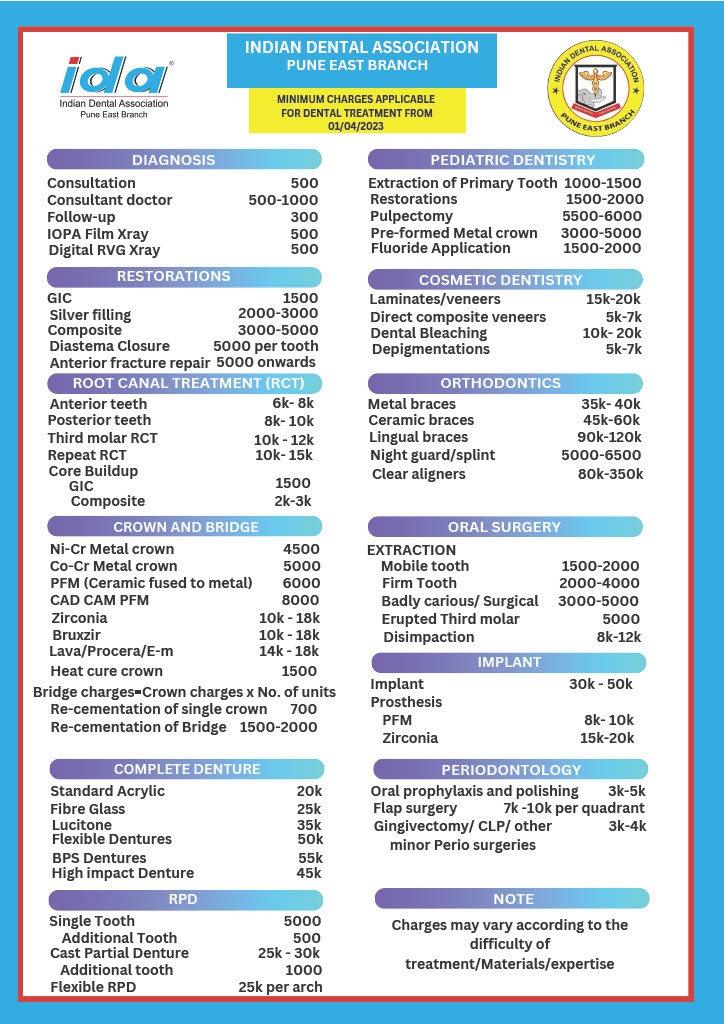
Our current published fees for ultrasonic scaling are ₹2,500 for Grade I, ₹3,500 for Grade II and ₹4,500 for Grade III, depending on how much tartar and inflammation there is. A localised cleaning around a single problem area, such as an inflamed wisdom tooth, is from ₹1,000. The grade and final cost are confirmed after examination. The full list is on our online fee catalogue.
Professional cleaning only resets the clock. Daily cleaning keeps it reset. Your dentist will show you how to brush along the gumline with a soft brush and how to clean between the teeth with floss or interdental brushes sized for your gaps. An antiseptic mouthwash may be prescribed for a short period. Antibiotics are used only in particular situations, alongside cleaning, never instead of it. If you smoke or chew tobacco, stopping makes more difference to the outcome than almost anything else.
A few weeks after deep cleaning, the gums are measured again. Many pockets become shallower and bleeding reduces. Where deep pockets remain, the bacteria can still hide there.
For persistent deep pockets, a periodontist may recommend flap surgery: the gum is gently lifted, the roots are cleaned under direct vision, and the gum is stitched back closer to the tooth. Our current published fee for flap surgery is ₹8,000, and the final cost depends on how many areas need it and is confirmed after examination. Other procedures, such as grafts for recession, are planned case by case.
Periodontitis is controlled, not cured. Regular maintenance cleanings, often every three to six months to begin with, keep it stable. Skipping them is the most common reason gum disease returns.
Dr Avinash Bamane or Dr Rashmi Bamane sees you first, examines your gums and explains the plan. Where specialist care is needed, they bring in a visiting consultant from our MDS periodontics department, who sees patients at Kharadi by prior appointment. You can book a consultation online; a booked consultation is ₹500 and an MDS specialist consultation is ₹1,500.
Kharadi runs late. Reception will tell you honestly whether you need an appointment yet.
Book — Rs 500 ☎ 8484990678