what is the difference between decay in enamel and decay in dentine
Enamel decay affects the hard outer shell of the tooth. It has no nerves, so it is painless, spreads slowly and, at the earliest stage, can harden again with fluoride. Dentine decay has reached the softer layer underneath, which is connected to the nerve. It spreads faster, often causes sensitivity, and needs a filling.
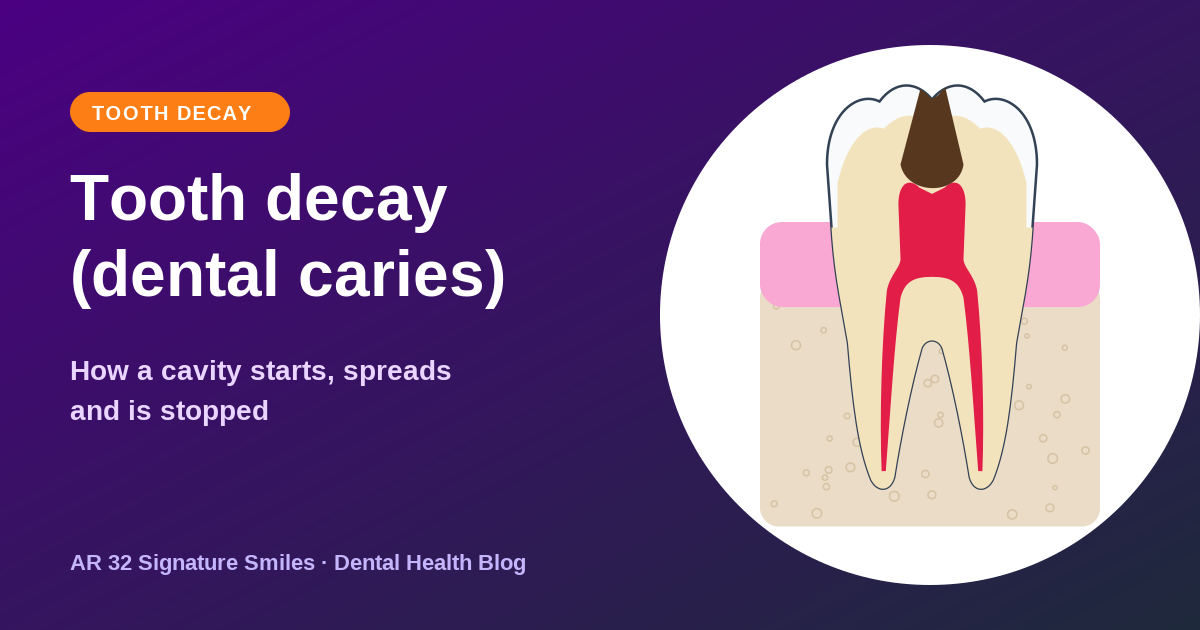
A tooth is built in layers, and the layer the decay has reached decides almost everything: whether it hurts, how fast it moves, and whether it needs a filling. Our page on tooth anatomy shows the layers.
The two layers
- Enamel is the outer shell, the hardest substance in the body. It is mostly mineral, has no living cells and no nerves.
- Dentine lies under the enamel and makes up most of the tooth. It is softer and yellowish, and it is full of microscopic tubes that run inwards to the pulp (the nerve and blood supply inside the tooth).
Side by side
- How it looks. Enamel decay: a chalky white or light brown spot, surface intact or only slightly rough. Dentine decay: a brown or dark area, often with a visible hole, or a grey shadow showing through the enamel.
- How it feels. Enamel decay: nothing, usually. Dentine decay: short, sharp twinges with sweets, cold or food pressing in, because the tubes carry the stimulus towards the nerve.
- How fast it spreads. Enamel decay: slowly, often over months to years. Dentine decay: faster, and it tends to spread sideways under the enamel, so a small hole on top can hide a large cavity beneath.
- Can it reverse? Enamel decay: yes, at the earliest stage, if the surface has not broken. Dentine decay: no. The softened dentine has to be removed.
- Treatment. Enamel decay: fluoride, fewer sugar exposures, cleaning, monitoring, sometimes a small filling or sealant. Dentine decay: a filling, sized to the decay.
Our pages on decay in enamel and decay in dentine go into each stage.
Why the line matters
The boundary between enamel and dentine is where decay changes character. Once bacteria cross it, the tooth's natural defences cannot win on their own. That is why dentists look so carefully at X-rays: a shadow confined to the enamel may be watched, but one that has crossed into the dentine is usually filled.
Deep dentine decay
When dentine decay gets close to the pulp, the nerve becomes irritated. Sensitivity starts to linger after the trigger, and the tooth may ache on its own. Your dentist may place a protective lining under the filling to help the nerve settle. If the pulp is already inflamed beyond recovery, root canal treatment is needed instead of a simple filling. Many root canals can be done in a single sitting, but some need two or more visits.
What it means for you
You cannot tell for certain which layer is involved by looking in a mirror. A short examination, with an X-ray if your dentist advises it, gives the answer. Our current published fees for composite (tooth-coloured) fillings start from ₹3,500 for a chewing-surface cavity and ₹4,500 for one between back teeth, listed in our online store. The final cost is confirmed after examination, because dentine decay is often larger than it looks from outside.
Want this looked at properly?
Kharadi runs late. Reception will tell you honestly whether you need an appointment yet.
Book — Rs 500 ☎ 8484990678Related questions
Read the full guide
Complete articles from our dental health blog, written by our MDS panel.
 Tooth decay and fillingsTooth decay (dental caries)12 min read
 Teeth: anatomy and scienceTooth anatomy5 min read
 Oral health and general healthDiabetes and oral health5 min read