i have a hole in my tooth but no pain what does that mean
A hole with no pain usually means decay has broken through the enamel but has not yet inflamed the nerve, or that the nerve has already died. Either way, it will not heal on its own. Filling it early is simpler and cheaper than waiting for pain, which often means a root canal. Book a check within a week or two.
Many patients are surprised to hear that a large cavity can be completely painless. Pain is not an early warning system in teeth; it is often a late alarm. A painless hole is not a reason to relax.
Why it does not hurt
- The decay has not reached the nerve yet. Enamel, the outer shell, has no feeling. Dentine, the layer underneath, can be sensitive, but slow-growing decay gives the tooth time to lay down a protective layer and the pulp (the nerve and blood supply inside) may stay calm for a while.
- The nerve has already died. If you had a bout of toothache in that tooth months ago that faded, the pulp may have died. Infection can then spread silently into the bone at the root tip.
- It is not decay at all. A notch at the gum line can be wear from hard brushing (abrasion) or from grinding, and a smooth, scooped area can be acid erosion. These look like holes but have different causes and treatments.
What happens if you leave it
Decay keeps spreading, often faster in the softer dentine than in the enamel, so the hole you see is usually smaller than the damage underneath. Food packs into it, making it harder to clean. Over time, a few things tend to happen:
- The nerve becomes inflamed, and you start feeling cold, heat or night pain.
- A wall of the tooth weakens and breaks off, often while eating something hard.
- An abscess forms at the root, sometimes with sudden swelling.
Each stage needs more treatment than the one before. A filling can become a root canal and crown, and a root canal can become an extraction. Our explainers on decay in dentine and decay in the pulp show how this progresses.
What your dentist will check
A small digital X-ray shows how deep the decay is and how close it comes to the nerve, which you cannot judge by looking. Your dentist will also check whether the nerve is alive and look for other cavities, because decay rarely affects just one tooth. If the cavity is in between teeth, the neighbouring tooth often needs attention too.
What treatment usually looks like
- Shallow or moderate decay: a tooth-coloured composite filling. Our current published fee is from ₹3,500 for a Class I composite restoration, with larger or front-tooth fillings costing more, as listed in our online store.
- Deep decay near the nerve: a filling with a protective lining, and sometimes a period of watching to see if the nerve settles.
- Decay into the nerve, or a dead nerve: root canal treatment, usually followed by a crown. Our current published fee for root canal therapy is ₹9,000, before the core build-up and crown.
- Wear or erosion notches: sometimes a bonded filling, along with changing the habit that caused them.
The final cost is always confirmed after examination. The difference between the first and last options is a strong reason not to wait for pain. Read more about fillings, or book online.
Want this looked at properly?
Kharadi runs late. Reception will tell you honestly whether you need an appointment yet.
Book — Rs 500 ☎ 8484990678Related questions
Read the full guide
Complete articles from our dental health blog, written by our MDS panel.
 Oral medicine and mouth conditionsMouth ulcers5 min read
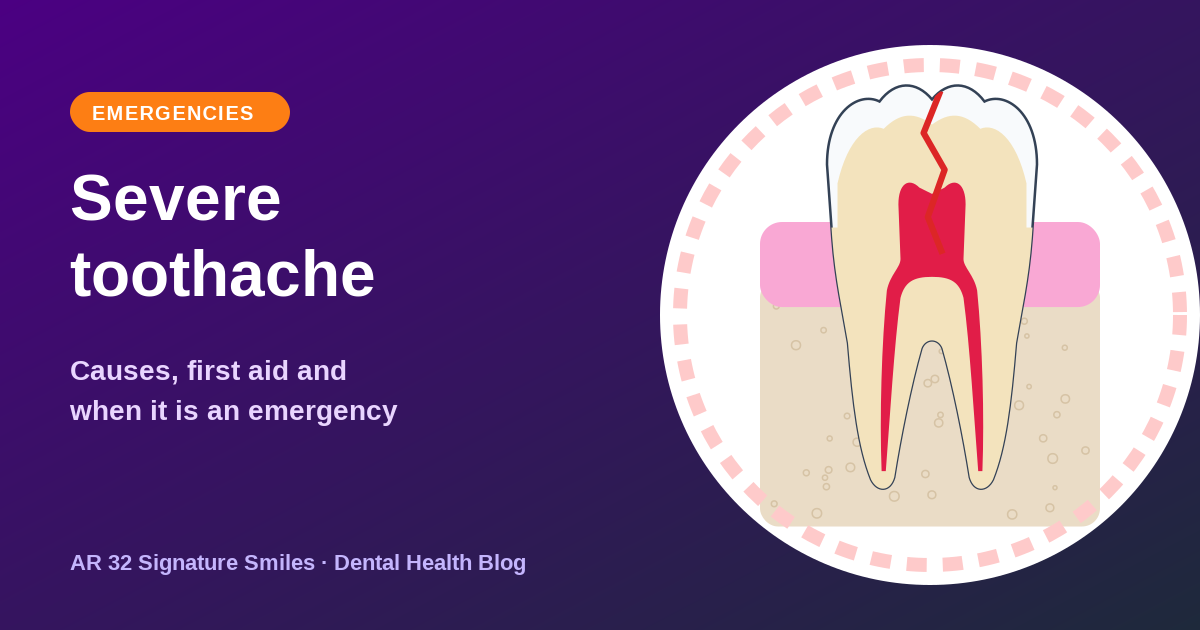 Dental emergenciesSevere toothache6 min read
 Teeth: anatomy and scienceTooth anatomy5 min read