Menu

Around Kharadi

411014411036411006

Wagholi side

412207411047411015

Hadapsar side

411028411013

Everywhere else

All areas we serve

how does a dentist decide if a root canal will work

By Dr Sourabh Mategaonkar (MDS, Endodontics) · Last reviewed 23 October 2026 · 501 words

The short answer

Your dentist predicts whether a root canal will work from the X-ray and examination: whether there is enough tooth to restore, how healthy the gums and bone are, whether the root is cracked, how complex the canals look, and how large any infection is. Most root canals on well-restorable teeth do well, but none can be guaranteed.

Root canal treatment removes the infected or inflamed pulp (the nerve and blood supply inside the tooth), cleans and shapes the canals, and seals them. Whether that succeeds depends partly on the skill and care of the treatment, and partly on the tooth itself. Before starting, a careful dentist looks for signs that tell them how likely success is.

Signs that favour success

  • Enough sound tooth to rebuild with a core and a crown, so the seal can be protected.
  • Healthy gums and bone around the tooth, with no deep pockets.
  • Straight, visible canals on the X-ray.
  • A first-time treatment rather than a redo.
  • A small or no infected area at the root tip.

Signs that lower the odds

  • A vertical root crack. This is the most common reason a "successful" root canal still fails. Cracks often do not show on X-rays.
  • Decay below the bone level, leaving too little tooth to hold a crown.
  • Severe gum disease with significant bone loss.
  • Very curved, narrow or calcified canals, or extra canals that are hard to find.
  • Previous treatment with problems: a broken file, a perforation, or a short, poorly sealed filling.
  • A large, long-standing infection that has destroyed much bone.

Extra information that sometimes helps

Several X-rays from different angles may be taken. For suspected extra canals, cracks or curved roots, a CBCT (a 3D dental scan) may be advised; we'll tell you where it's done and what it costs. In difficult cases Dr Avinash or Dr Rashmi can bring in our MDS Endodontics department by prior appointment at Kharadi.

What happens after matters too

Many root canals that fail do so not because of the canal work but because the tooth is left without its final restoration, leaks, or breaks. A back tooth that has had a root canal usually needs a crown soon after. Delaying the crown for months to save money is one of the commonest reasons we see teeth crack.

Honest expectations

Your dentist should tell you plainly if the outlook is good, fair or doubtful, and what the alternative would be if it fails, such as re-treatment, minor surgery at the root tip, or extraction and replacement. Many teeth can be treated in a single sitting and some need two or more visits; the number of visits does not by itself decide success.

Questions worth asking before you start

  • Is this tooth restorable afterwards, and what will it need on top?
  • Do you see any sign of a crack or gum pocket on one side?
  • How complex do the canals look on the X-ray?
  • If it does not heal, what would we do next?

If the answers suggest a doubtful tooth, it is sensible to weigh the full cost of saving it against the alternatives before you begin.

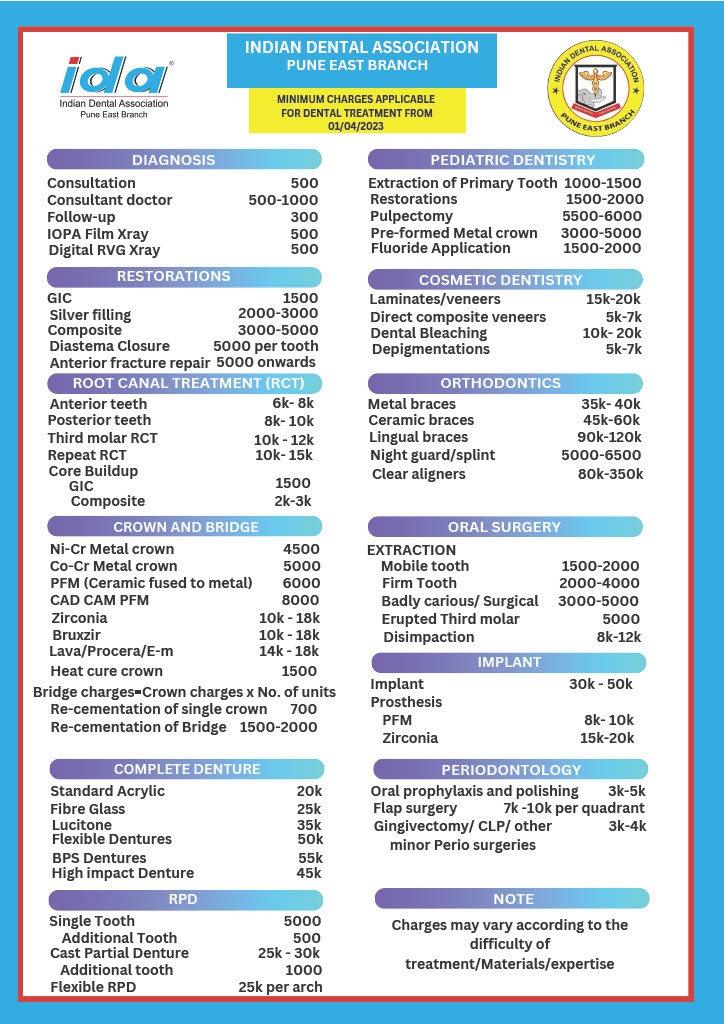
Our current published fees, listed in our online store, are ₹9,000 for a root canal and ₹10,000 for re-treatment; the final cost is confirmed after examination. Learn more on our root canal page.

Answered by Dr Sourabh Mategaonkar, MDS — Department of Endodontics, AR 32 MDS panel
Reviewed and approved by Dr Avinash Bamane, BDS — registration A-18814
Last reviewed 23 October 2026 · next review due October 2027
This answers a general question. It is not a diagnosis, and it cannot account for what is actually happening in your mouth. If something hurts, get it looked at — by us or by anyone.

Want this looked at properly?

Kharadi runs late. Reception will tell you honestly whether you need an appointment yet.

Book — Rs 500 ☎ 8484990678
Related questions

what is a pulp vitality test why did my dentist say wait and watch what happens if a diagnosis is missed how does a dentist diagnose a dental problem when do i need a cbct scan instead of an x ray All how we diagnose questions →