Your dentist weighs how much sound tooth is left, the health of the gum and bone around it, whether a crack runs into the root, how important the tooth is to your bite, your overall health, and the cost and long-term outlook of saving it versus replacing it. Usually saving a natural tooth is preferred when its outlook is reasonable.
Keeping your own tooth is usually the best outcome; no implant or bridge is quite as good as a healthy natural tooth. But not every tooth can be rescued, and spending heavily on one that will fail within a couple of years can cost you more than removing it and replacing it properly. The decision rests on a few clear questions.
If decay has gone below the gum and into the bone level, there may be nothing solid left to hold a crown. Sometimes a minor gum procedure (crown lengthening) or orthodontic pulling-up of the root can rescue it, but these add cost and time.
A vertical crack that runs down the root is generally not repairable. Such teeth often show a narrow, deep gum pocket on one side or a particular bone pattern on the X-ray. Sometimes the crack is only confirmed once the tooth is opened. A crack confined to the crown, by contrast, is often saved with a crown.
A tooth that has lost most of its bone and is very loose has a poor outlook even if the crown is perfect. Our MDS Periodontics department can assess whether gum treatment can stabilise it.
Infection that keeps returning, blocked or very curved canals, broken instruments or a perforation can make saving the tooth difficult. A specialist from our MDS Endodontics department may give a view on whether re-treatment is realistic.
A first molar that does much of your chewing, or a tooth needed to support a bridge, is worth more effort than a wisdom tooth with no opposing tooth to chew against.
Uncontrolled diabetes, smoking, some bone medicines and radiation treatment affect both healing after extraction and the success of implants. Your time, budget and willingness to attend several visits also count. These are legitimate factors, not weaknesses.
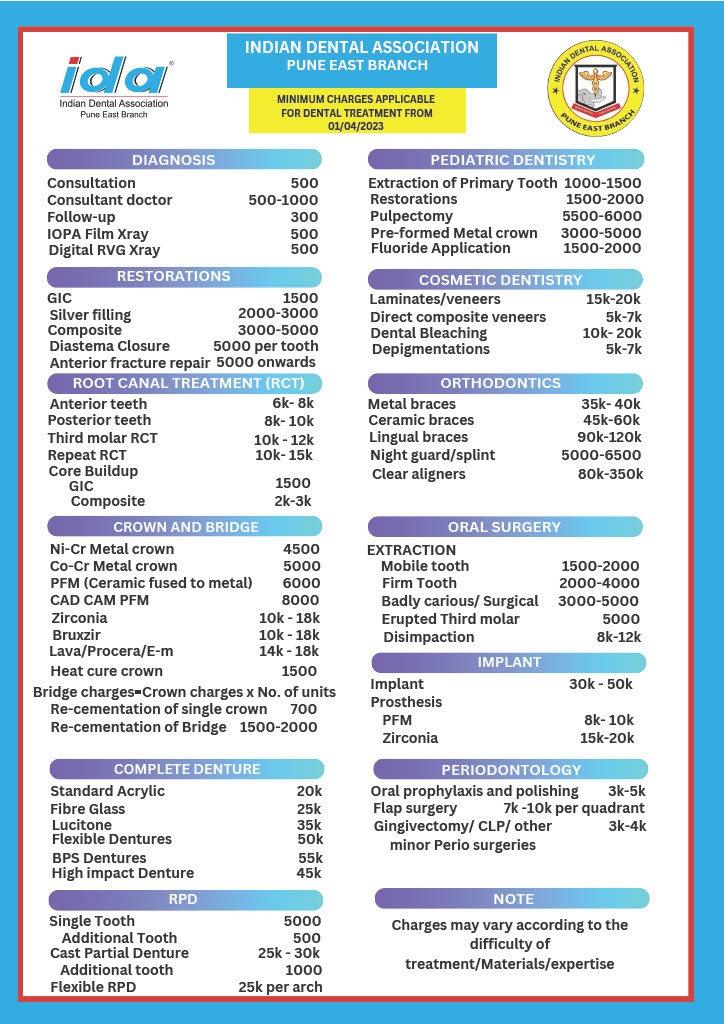
Saving a molar typically means a root canal, a core build-up and a crown. Our current published fees are ₹9,000 for a root canal, ₹3,000 for a core build-up and crowns from ₹3,000. Replacing it after extraction could mean an implant, from ₹80,000, or a bridge. Extraction itself starts at ₹1,000 for a basic case. All are listed in our online store, and the final cost is confirmed after examination.
So when the outlook is fair, saving usually wins on both comfort and cost. When the outlook is poor, removing it sooner can protect the bone needed for an implant later. Leaving a gap unreplaced is also a choice, but neighbouring teeth can drift and the opposite tooth can over-erupt over time.
At our clinics the plan is written down so you can decide calmly, away from the chair. More is on our tooth extraction page.
Kharadi runs late. Reception will tell you honestly whether you need an appointment yet.
Book — Rs 500 ☎ 8484990678