It depends mainly on how much healthy tooth is left. If the cavity is small and the walls are strong, a filling is enough. If decay or an old filling has removed much of the tooth, a cusp is cracked, or the tooth has had a root canal at the back, a crown is usually safer.
Patients often ask why one tooth gets a filling and the next one needs a crown. The answer is mostly engineering. A filling repairs a hole in a tooth that is still strong. A crown (a cap) covers and holds together a tooth that has become weak.
Between a filling and a full crown is an onlay, a lab-made piece that covers one or more cusps while preserving the healthy sides of the tooth. It is useful when a filling is too weak but a crown would cut away more healthy tooth than necessary.
Because a crown is not free of cost to the tooth. Preparing a tooth for a crown removes healthy enamel all round, and once done it cannot be undone. Crowned teeth can still decay at the edges and occasionally need a root canal later. If a filling can do the job, it is usually the better choice. Equally, an oversized filling on a weak molar often fails by breaking the tooth, sometimes below the gum, which can mean an extraction.
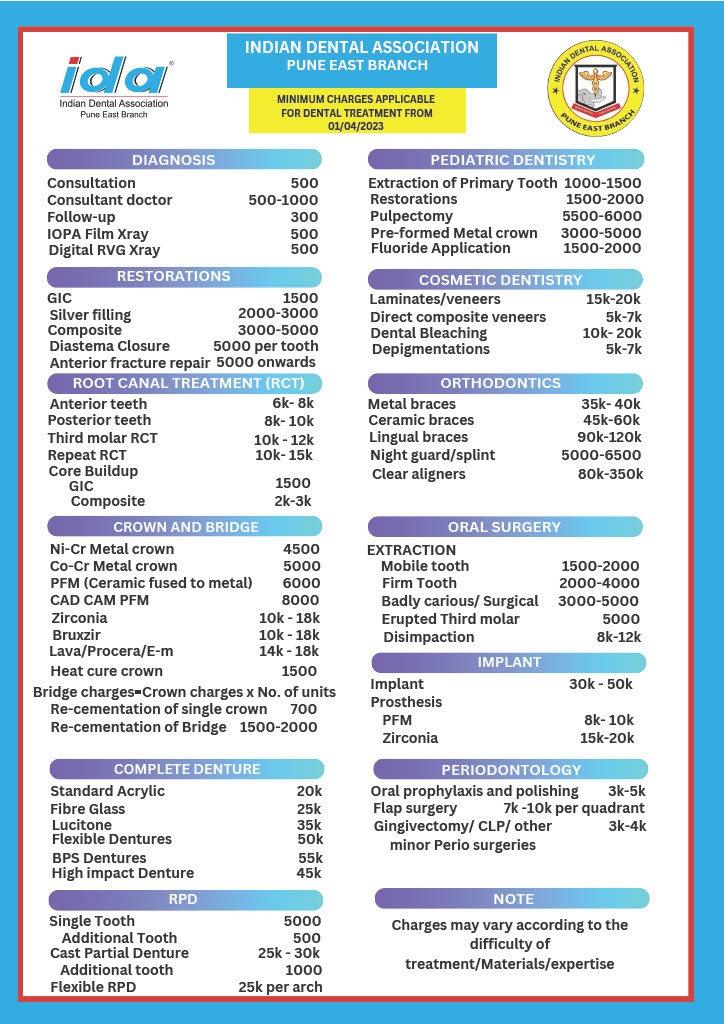
Our current published fees, listed in our online store, are: composite fillings from ₹3,500 (back teeth) to ₹6,000 (front teeth); onlay ₹8,000; core build-up ₹3,000; crowns from ₹3,000 (metal) through ₹9,000 (PFM) and ₹12,000 (zirconia) to ₹16,000 for an advanced aesthetic zirconia crown. The final cost is confirmed after examination. A filling is cheaper today, but a filling that breaks the tooth can cost much more later. Ask your dentist to show you the remaining tooth on the X-ray or a photograph so you can see the reasoning.
See our pages on fillings and crowns and bridges.
Kharadi runs late. Reception will tell you honestly whether you need an appointment yet.
Book — Rs 500 ☎ 8484990678